tag:eitw.nd.edu,2005:/articlestag:eitw.nd.edu,2005:/latestEurope in the World | Articles2025-10-23T07:00:00-04:00Analyses and commentary of Europe's political, social, and economic relations with the rest of the globe.tag:eitw.nd.edu,2005:News/1756082025-10-23T07:00:00-04:002025-10-15T15:39:26-04:00Laura Shannon Prize Seminar 2025: A Conversation with Author Katriona O'Sullivan
This summer, the Nanovic Institute for European Studies hosted a weekend conference at the Kylemore Abbey Global Centre in Ireland, bringing together several past recipients of the Laura Shannon Prize—one of the preeminent book prizes in the European studies field, which carries an award of $10,000—alongside Notre Dame graduate students, faculty, and guest authors. The conference theme, Storytelling from the Margins, invited reflection on how certain voices and narratives have been historically pushed to the periphery—and what that means for both those storytellers and the world of literature today.
This dicussion between Jacob Kildoo of the Nanovic Institute and award-winning Katriona O'Sullivan, author of the Irish best-seller Poor, provides insights to O'Sullivan's complex process of writing about trauma, her thoughts on the systemic barriers to opportunity in the world of literature and higher education, and her own struggles and triumphs while writing Poor. O'Sullivan shares excerpts from her book and answers audience questions in the concluding Q&A session.
Transcript included below.
Jacob Kildoo: Well, welcome everyone. Thanks for coming. I’ve been really looking forward to this session, for weeks really. I’ve been looking forward to the whole event for weeks, but in particular, I'm very excited for this session. Just really pleased to be here with Katriona O’Sullivan to spend some time talking about her memoir, Poor. I’ll introduce Katriona more fully in just a minute, but I wanted to offer a few words about the book and some of the larger questions that it invites us to sit with. Our retreat this week has revolved around the theme of “Storytelling from the Margins.” I think at its heart, this way of framing things invites us to reflect on a lot of really big questions around how "centers" and "margins" are constructed and how this pushes certain kinds of stories to the outskirts and privileges other kinds of stories.
I think this idea invites us to reflect on important questions like, who’s historically been allowed to tell their story? Whose stories are deemed worthy of attention and scholarly analysis? And on whose terms? As educators and researchers, I think too often we see marginalized perspectives treated as something to interpret, or explain, or in the worst cases, even rescue. But I think the idea of storytelling from the margins prompts us to ask a different kind of question. That is, what happens when we step back and allow people in marginal positions to actually tell their own stories? To narrate their own experience, and to do that on their own terms?
I think Katriona’s book gives us a really powerful answer to this question. It's a memoir that resists neat categorizations. It's at once a trauma narrative, a trenchant critique of institutions, a reflection on social class, and in important ways, it's an inspirational success story too. It can be all these things together because it insists on narrating the complexity of a real life lived on the edges of society. And because it's told in a voice that's really unclinching and intelligent and just deeply humane too.
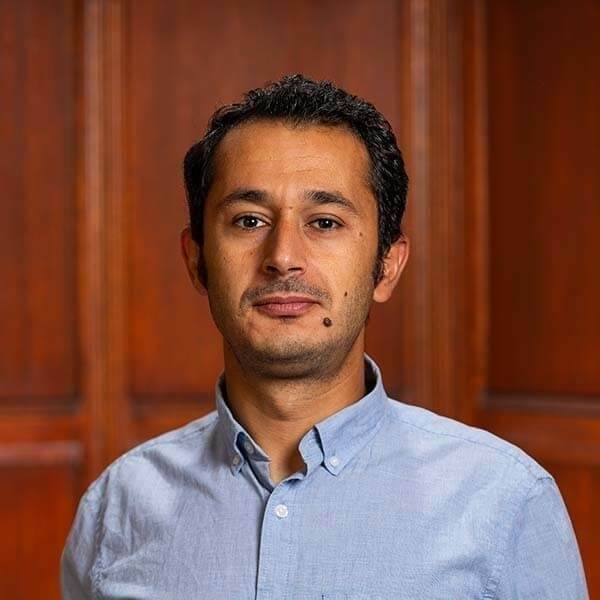
On that note, I'll introduce Katriona here. Dr. Katriona O’Sullivan is a professor in the Faculty of Science at Maynooth University. A psychologist and a memoirist, her first book, Poor, debuted at number one on the Irish non-fiction bestseller list. The book, a memoir of growing up in extreme poverty, describes the far-reaching impact of childhood poverty. As one of five children in a home shaped by her parents’ heroin addiction, Katriona's story chronicles her journey from poverty, teenage pregnancy, and homelessness to graduating with a PhD from Trinity College, Dublin, and becoming an award-winning lecturer whose work challenges barriers to education.
Katriona's CV is immense. I'll read just a few highlights. She's the principal investigator on the award-winning STEM Passport for Inclusion Project. She's held research grants from the Irish Research Council and Science Foundation Ireland. She's been an invited speaker at the UN, Westminster, the World Education Forum, the European Gender Action Workshop on Women in Digitalization, and most recently at the UN Gender Equality Workshop. She's worked with Irish policymakers to develop policies around education and inclusion, and she's published research on equality, gender, education, inclusion, and STEM.
Wow.
So for the choreography, we’ll have Katriona read a bit from her book, a few excerpts, then we’ll commence with a bit of an interview, then we’ll open up things to Q&A with the audience. So, let’s give Katriona a warm welcome.
Katriona O'Sullivan: Thank you. It's so lovely to be here, and thank you for being so supportive and fanning, which is lovely that my book has reached people internationally as well as nationally. So, I'm a professor in the Faculty of Science at Maynooth University. Just to contextualize who I am and my story, I always start at the end, because it's the best bit. Professor of psychology – I graduated with a PhD from Trinity College in 2012, 2008. A first-class honors degree from Trinity College in psychology. If you don't know what first-class means, it means I'm f***ing amazing. I swear a lot, by the way, and it's not at you, but that's part of my vernacular where I come from.
I start at the end, more importantly actually than my educational outcomes and my employment outcomes, because sometimes I think when we talk about success, we frame it in terms of economics. I'm loved. Every morning I wake up, I have an amazing husband and three lovely kids. Every morning I wake up, my husband goes downstairs and makes us a coffee on our fancy coffee machine, because I'm not poor anymore. We do Wordle together, because I'm intellectual now. And then he says, "I love you." On days like today where I'm coming here, he'll say, "It doesn't matter what they think. I think you're amazing." I think the gift of education, employment, and opportunity for poor people, sometimes we lose why we're doing this. It's to provide people with enough security to achieve what we all want, which is connection. I feel very blessed and gifted to have that, because if you knew me 27 years ago now (I used to say 25), I lived in a one-room bedsit that was probably like from that glass panel to that glass panel with my seven-year-old son. I was completely social welfare-dependent. I'd never had a—I had a cash-in-hand job. I used to clean toilets in a train station. If you knew me then, you just don't expect women like me to end up here.
Or 30 years ago, 32 years ago, 16, homeless, living in a homeless hostel with an eight-month-old baby. I'd left school a year before without any qualifications, and I was completely alone and terrified and unable to ask for help, a chip on my shoulder with the anger. If you knew me then, we just don't expect these outcomes. Or 41 years ago, I'm the seven-year-old daughter of two intravenous heroin addicts, and I wake up every day hungry, not just for food, but for a hug and for someone to teach me that I'm valuable, show me that I have potential, teach me how to regulate my emotions. So that's who I am and where I come from.
My book is the story of how I got here, and it's not a story of grit, because grit will not get you here. It's a story of the people and the policies and the practices that actually allowed me to escape my destiny, because poverty is a destiny in the same way that privilege is. So Poor is my—it's my intellectual and my personal experience combined to try to make people think. We think more, I think, when we hear real stories. Hurt helps us. Intellect does as well, but it's very dry and boring. Nobody reads my intellectual papers as much as they've read this, to be honest. I'm going to read you a few excerpts from my book and then we'll have some questions and answers.
This is a story of when I was in school as a child.
I was wetting the bed every single night. Children tend to do that when they're in a crisis. Then going to school without washing or changing my pants. I didn't know how to wash. There were no towels in our bathrooms, barely any toilet paper, never any soap, none of us owned a toothbrush. In the toilets with Miss Hall, I felt ashamed, as though it wasn't just the kids who teased and mocked me. "Pissy pants, pissy pants, smelly b****." "I don't want to sit with Katriona, miss. She smells like wee." I knew that Mrs. Arkinson and Miss Hall thought I was smelly too. It was true. I stared at the floor. "Couldn't she just leave me alone?" I didn't want to talk about it. I didn't want to talk to anyone. "Miss..." I might cry, actually, it's okay to cry. Miss Hall crouched down and said quietly and kindly, "Katriona, you're not in trouble. We're going to help."
I did need help. I could sense it in the relief I felt from her words and looking at the pants. They had pictures of little girls in T-dresses on the front and days of the week stamped above the picture. "Monday, Tuesday, Wednesday, Thursday, Friday," she said, landing her finger on each one as she said the word. I looked at Miss Hall and she was looking at me. I wanted to reach out and touch her fluffy hair and silky blouse with the big loose bow at the neck of it. She was so clean and pretty and smelled lovely. I sometimes wonder if she was, she could actually be Princess Diana. They looked the same to me. Maybe it was really her, a princess in our class.
"When you come into school in the morning, before everyone else, I want you to come to my desk and I will give you a set like this." She showed me a white flannel and a white towel and lifted one pair of pants onto the small pile. "You take them and come into the loo and lock the door just like I did, okay?" I didn't nod or shake my head, I just stared at the floor. "Do you wet the bed?" she asked, crouching to look up at my face. I flinched but didn't answer. She pushed my hair back. "Head up now," she said. "Nothing to be ashamed of, but let's learn to keep ourselves fresh and clean." There were three little sinks and she chose the last one. Explained how to run the water warm and showed me how to wash. "Start on our legs," she said, after I took off my yellow-stained pants. She threw them into the bin straight away. "Get the flannel, wet it in the warm water, then we twist this so it won't drip. And now we rub our legs like this." She showed me how. Up and down and from my knees. The way she kept saying "we" felt nice. I was never part of a "we." "Head up, Katriona," she reminded me. "Nothing to worry about. We're only learning how girls wash, is all." She wiped across my groin and around my hips and bum. She showed me again, "Up and down, wash, wash, wash, around and under," and asked me how to show, asked me to show her how to do it myself. I did, repeating the words as she said them. "Then dry like this," she said, patting my skin and giving me the towel to repeat the action myself. "Now pop on your Monday pants," she said, handing them to me. She repeated my new routine. I was to come in every day and use the girls' loo to wash like she showed me and put on my new pants. She would keep the pants in school and every morning she would give me the bundle of flannel and towel and a pair of pants. My used pants went back into the little bag. There was a small stand in front of the cubicles and she showed me where to leave the bag when I was finished. I never thought about what happened to it after I left my clean pants on. But of course it was making its way to Mrs. Arkinson's washing machine and back into school for the following week. I stood there in clean pants with clean legs. "Now," she said, "what a great girl." I felt as though I was standing in a beam of sunlight. She would never know what she did for me. How in that small bundle of towel, flannel, and pants, Miss Hall gave me power. In that small bathroom, every morning before the girls came in, I was in control of one thing.
That's the first story.
This is me now as a chubby single mother, on my journey into recovery, looking for something, knowing that there was more. I'd started therapy, I'd asked for help, and I was in Dublin.
Trinity College was a landmark. I hadn't seen my friend Karen in ages, so when I saw her across on O'Connell Bridge, I stopped to say hi. She wasn't surprised to see me, and of course she stopped to chat. Everyone knows everyone in town. We stood on the median together. "What are you up to?" I said to her. "I'm in Trinity College," she said. "I'm studying law." My heart started to pound in my chest. "No way, Karen," I said. Karen was a townie, through and through. Brought up in abject poverty in the city center like me, and a single mother like me. Her dad was Joe Dowling, the wonderful man who ran the little center in North Strand where I used to call in all the time for support. "What are you doing?" she asked. "I'm working in the canteen," I said, waving the question away with my hands to get back to the reason my adrenaline was spiking. "What do you mean, you're in Trinity College?" She took a minute to light a cigarette and put her bags down between her legs. "Yeah," she said. "I'm studying law." "Law, like law-law?" I was baffled. "In Trinity College, like?" I pointed at it, the grey walls and buildings in view from where we stood. She nodded, took a drag. "Yep." "How the..." I felt something stir. Was it jealousy? "I did the access program there," she said. "It's for girls like us, Katriona. You go in and learn how to go to college. At the end, you can pick your course for a degree." "For real?" I said. "Ah, here, Karen, they'd never let me in the door of that place." I tried to joke but I could barely hear myself over the pounding of my heart. A beam of sunlight had lit the street. "How did you get on in it? How did you get onto it?" I said. I put my purse back in my pocket. Pennies could wait. Trinity College was a landmark, somewhere lads I knew went to rob bikes. I never looked at it when I passed it, never thought about what was going on in there. I didn't care about its history or what it stood for. There was nothing for me in there. So my dreams were limited. I didn't have anyone talking about college or university around me. Nobody even mentioned it. In school, the teachers hoped kids like me would make it through the GCSEs and go on to do a trade. In poor areas like ours, kids were encouraged to do hairdressing, childcare, and catering, not history, politics, or maths. Years later, I would argue against the corralling of poor kids into trades and low-level careers and be shocked to my core at the widespread belief amongst educators that those born into poverty lack the brains for third-level education. I fight this nonsense every day.
On O'Connell Bridge that afternoon, Karen explained to me how she got into Trinity. She started at the beginning. Told me about the Trinity Access Program, how people like me could apply to do a course where you'd be helped to go to college or university. She said she loved it, told me it was brilliant. Said there was loads of support and the people running the course were great. "I'd love to do something like that, Karen," I said. She dropped the cigarette and stood on it. "And they pay you," she said. "You get childcare and all." I I started to pinch, I wanted to pinch myself. The ground under my feet was turning into gold. "Where is it on?" I'd love to see a video of myself marching over to Westland Row that day. I could not move fast enough. I was a woman on a mission. For the first time in my life, I knew where I was going. I was going to Trinity. There was a security guard on the door to the building around the back of the campus across from the DART station. I asked him to show me where to find the Trinity Access Program, and he showed me, so he pointed me to the door with the glass window. I knocked and looked in the window, and the lady in there glanced up and waved to me like she knew who I was. "Hi," she said, and beckoned me to come in. She had a small, stern face under a mass of brown curls. I pushed open. "Hiya," I said. "I'm I'm my name's Katriona O'Sullivan, and I want to go to college. I know Karen Dowling, and I just met her and she told me she goes here. How is I, how am I going to go here? I want to go here." She smiled widely. "Whoa," she said. Introduced herself as Irene. "Would you like to sit down?" I shoved myself on the seat. "Come on, come on, come on, let me in, let me in." "It's just," I said, "Karen Dowling is a single mother, I'm a single mother as well, and I want to go here. So when she told me, look, how can I go here? I want to go here." I felt I couldn't speak fast enough. "You want to go to the access program here?" she said. "Why?" "Why?" How could I ever explain? How could I speak on my, how could I speak on my life in a way that would even touch on the depth of why I wanted out of it? Where I lived, my life was considered a good one. I had my payment every week, I had my rent paid, I had my little job, the few bob on the side. I'd find a nice fella soon, right? I'd eventually get a council flat next door to a friendly face. What was wrong with that? Nothing. It just wasn't what I wanted. Not for me, and not for my son. It wasn't enough for me. "I want," I let the air out of my lungs that I'd been holding in since I'd met Karen. I looked around the room. Irene stayed quiet, she gave me a nod. "I want to know everything," I said.
And this is the last one. This is all after I'd done it all.
The Trinity Access Program played a huge part in my journey. It changed my life. It held out a hand when I was trying to climb out of the trenches. I'm hugely grateful to the program. And for many years, because I was so grateful, I championed the program blindly. I used to give talks to potential funders, telling them my story. I dressed the part, flowery, knee-length dresses from Oasis, tights, kitten-heeled shoes, clothes I didn't like, to show how much I'd changed. I played someone who had escaped the working classes. I didn't see the problem for a while. Being asked to represent the college was like a pat on the head or a gold star. But being educated has given me the ability to think. And with it came the opportunity to critically consider society in a different way. I asked myself, "What was it that these access programs offer? What do they do?" And when I did that, I saw things with new eyes.
When I was studying in the program, I was a popular student. The staff liked me. I was enthusiastic and I did well, and because of that, I was supported and encouraged. I was given information about grants and bursaries and how to get them. I got a scholarship to Trinity, childcare support. I was their good news story. My opinion changed when I started to work as part of the Trinity Access Program team. I began to understand that a charitable mindset shaped and directed the program. I began to see that the system that worked for me because I was good was failing others who were not good. I realized that the students who were celebrated were the people who got good grades, who toed the line and played the part, like I had. They were grateful to be in Trinity, worked their asses off to keep up with their studies, and were always keen to demonstrate that they were making the most of the opportunity. They allowed themselves to be paraded like show ponies at fundraising events. While these students did well, the other ones, the other ones who struggled more did less well. They weren't invited to events. And at staff meetings, they were spoken of in hushed tones. I figured out that only certain types of people, or a certain type of poor person is welcome at Trinity. And that is the one who never tries to rise above the program and remains eternally grateful for the charity it offers. Once I started to see those things, I couldn't unsee them. Just to be clear, Trinity doesn't want me to work for them now. Looking back, I realized that taking the access students across to the road behind, from the main campus was telling. It might not have been intentional, it might have been a practical option that seemed to work, but I couldn't help thinking there was something deep in that decision. Locating the poor students away from the main body of Trinity, it has a subconscious effect on the students themselves. Unseen, unheard, unwanted. Access programs are a bandaid on a broken education system, often run by the middle classes and funded by the elite. Neither of whom can fully understand what it's like to be discriminated against, either in education or in life. These programs ask applicants to prove their poverty, prove their inequality, prove their worthiness, prove their motivation, prove their potential, and it selects the ones it believes are worthy of the gift of an education. The more I thought about it, the harder and harder my job got. I saw things that made it impossible to stay working in Trinity in the Trinity Access Program. I saw the project sold as one, I saw the project sold as one that saves poor people from the clutches of their own communities. Rich people donated, brows furrowed with concern, but their donations were not always about making the lives better, it was about, it was about being identified as a Trinity donor. Maybe patting themselves on the back a little and changing nothing. Indeed, wittingly or unwittingly, these structures uphold and reinforce inequality. Many times when I stood there appealing to alumni to dig deep for the poor, I may have been the smartest person in the room. And that's the kind of problem, that's kind of a problem. I graduated with a first-class honors degree from Trinity College, despite growing up in a poor household, being poor. That helped me get where I am today. And yet, even with my PhD, my new research role in University, my prestigious research council funding, I knew I was still regarded with pity by the upper echelons of Trinity and by its well-heeled alumni as one of the charity cases.
That's me.
(Audience claps)
Thank you.
Jacob Kildoo: Thank you so much, Katriona. Those are moving snapshots into your story, and I appreciate you sharing it. Great. So I have a handful of questions. Yeah, I wanted to start with just sort of the beginning, the title of your book, Poor. You talk about this a little bit in the epilogue and sort of explain your rationale for wanting to frame things this way. I'll quote you here, you write that the term "poor" "cuts through a lot of jargon, words like disadvantaged, underprivileged, deprived, underclass." You say that those terms "they have their place, but they don't quite capture the visceral truth of what it's actually like to grow up the way you did." Can you talk about why it was so important for you to name that truth directly? And then could you also maybe talk about what storytelling, what it is about storytelling that allows you to express something that those more clinical terms can't quite get at?
Katriona O'Sullivan: Yeah, I think Poor makes people feel uncomfortable in some ways. It's a polemic term. I think one of the things that I've been privy to in my research career, in my academic career is the uncomfortableness of people in terms of naming disadvantage and using words like "underserved," "disadvantaged." Like, I've been in meetings where the same person has been like for five minutes gone, "disadvantaged, but underserved, but..." You know, like, people are so scared to name poverty and name social class and name what it's like. And so for me, it was really important to have a title that grabbed somebody and was totally honest. And also, it's a play on words, because there's an idea that people are poor. Like, we're poor. And for me, I think "poor" represents the poor system and structures in which I grew up. Like there were people in my childhood who had no power to do better by me, which were my parents. But there were people that had enough privilege and power to not reinforce the hurt that I experienced. And so for me, they are the poor people. And so I use "poor" interchangeably, and I think it's a nice conversation, but I also think it's very important in language to say "truth." To say, "I was poor." And I had poverty of mind, poverty of love, poverty of opportunity, poverty of fairness. So, and I think, yeah, when you write from a non-academic point of view, it sometimes gives you permission. You can break the rules, because we have rules in terms of, you know, subjectivity, objectivity, all these things. It gives you permission when you write, like I've written, to be able to say what you actually mean. And what's been really nice is actually hearing other people use the term more freely and not feel so embarrassed. And I think it's okay to say "poor" even if you weren't poor. We need to be comfortable naming the reality of people's lives. And it's not a criticism. Like if I work with people who are very privileged or have had very privileged lives, I have actually no problem with them saying, "Wow, you grew up really poor." They're more uncomfortable with that than I am, you know, because they feel like it's a difficult thing to say. So I called it Poor. Now, we got lots, we had lots of conversations about the title as well. I did want to call it "Go Your Own Way" at one point, but Fleetwood Mac would have cost us too much money, so we went with Poor, which I think is more polemic.
Jacob Kildoo: Yeah, that makes really good sense. Yeah, I want to get into sort of, reflecting on, Yeah, reflecting on the experience of writing the book itself. In the first chapter, you reflect a little bit on the difference between memories you want to hold on to, ones that bring you joy, which, of course, there are plenty of. But then there are others, of course, that weigh you down, but that you still feel compelled to, to tell people about. You say that you want to share those painful memories with the reader so that you can sort of leave them here and move on from them. That's how you put it in the chapter. Can you talk about the role that writing the book played in the process of sort of letting go? Was there a way in which sort of revisiting those memories helped you to move on, or did they maybe take on a new light or a new weight at different moments? How did that dynamic play out?
Katriona O'Sullivan: Yeah, I think when I wrote that line, that was very aspirational in the sense that, you know, I'd love it if I could just write it down and it'd be gone. But there was definitely something. I wouldn't recommend writing a book as honest as what I have written without therapy. I think there are people who are asked to write poverty stories who haven't actually had the opportunity to heal. And I think that's quite harmful and inappropriate in publishing. And I've seen the harm that that's done on friends. I, I'm lucky that I have, have been in therapy for a long time and also have had the privilege of, like, actually moving out of poverty to the point where it isn't as visceral today. So, but yeah, I think one of the really transformational parts of it was actually when you write about your life, your whole life, it's like you connect everything. So, like, I think we, you know, I don't know about everybody else here, but there would be memories from childhood and then there's memories from teenage years and then there's, so, like, but nobody really ever sits down and, like, links their whole life together and thinks about that little girl and then how she turned into a teenager. And so in my case, like, I had all this compassion for myself as a child. I could see how sad it was, the experiences I had as a child and how hurtful. And then all of a sudden, I became, like, this really judgmental adult who looked at my 13-year-old self who became a delinquent. I had this real harsh, judgy voice about her when I was writing. And having an editor, I remember sitting with my editor and she said, "I'm actually not going to allow you to talk about yourself like that." And that was really, really mind-blowing to me, because I actually couldn't see. I think we live in a meritocracy. All of us live in this world where it's taught from a very young age that we are responsible for our outcomes and hard work is the key to success. And that is the biggest lie that is taught to all people, as far as I'm concerned, because some of hard work is important, but, like, I could never, there was no amount of work that I could have done to escape what I was experiencing or to do better. And I had this, I had internalized that, and so when I was looking at myself as a teenager, that's how I wrote about myself. I failed at school, I didn't attend enough, I was, I fought with people, I smoked, underage sex, you know. And so the writing of the book gave me a real ability to see the beautiful little child that I was and how the hurt transformed into this lost young woman who then was just searching and so broken. And that was an amazing gift for me.
The other thing that it gave me was my mother became very static in the story. So when you can, when writing about her, I was able to find, like, so much love for her in writing about her. Like the memories of her joyful dancing, the way she, you know, that beauty. She had an amazing character. So it gave me the gift of being able to see the light and dark of humanity in my parents. And that was really wonderful. And like, the thing about writing a book is, the great thing about it is like when you write, you write anything, like, often times we we write it and it's really painful writing it even if it's a sh*t article we're doing or something for work. And then you never read it again. So like, I wrote this book and then like I obviously I talk about it now because it's become so popular. But like, once it's down, it is kind of gone, which is fantastic. But it was a brilliant process, but also really painful as well. And like, even in academic writing, like, you know, you get that moment where you have to push, you know, there's you you write something good, but you know it can be brilliant. But you have to go emotionally to a deeper place. And it might not be the same when you're writing about academics, but you still have to push yourself intellectually. With Poor, there were moments where I had to actually say, "Am I going to be honest?" There's a brilliant book by Tara Westover called Educated, and for me, her book is similar to mine, but she didn't say everything in my opinion. And I was like, "If I'm going to write this, I'm going to make you feel the brutality of poverty." I wanted everybody who read it to feel how hurtful it is for a child to be neglected. And so I think that was the hardest part, was actually getting into the words and saying, "This is how hard it is."
But I like myself more now after doing it. And I have a lot more forgiveness for myself.
Jacob Kildoo: Katriona, throughout the book, you express deep frustration about those circumstances that you grew up in. But there are also interesting moments too, and you actually, one of these came up in your third excerpt there, where you reflect on how growing up poor gave you certain kinds of skills, insights, or instincts that actually really helped you succeed later on. One moment that stood out to me is when you describe a research project that you were doing at Trinity, and how you had developed this childhood habit of sort of keeping tabs on your parents, and this sharpened your ability to sort of "join dots," is how you put it, and think like a researcher. What did it mean to, like, recognize those kinds of unexpected strengths? Maybe you already knew them or thought about them that way before you wrote the book, maybe some sort of emerged as you were writing. And how did that, like, shape your sense of belonging in spaces like academia, for instance, that are often dominated by people from more privileged backgrounds?
Katriona O'Sullivan: So, yeah, I don't feel like I belong in academia a lot of the time still. I don't know if anyone really feels like they belong, so when I do say it's to people, secretly we all feel like we're going to get kicked out, I think, at some point or another, unless you're one of my colleagues who's an a**hole. But, I never, yeah, so I don't think anybody should have to go through trauma. I think trauma is.… People should be protected. But like growing up poor….like that story about meeting Karen, and marching over to Trinity College, like none of my privileged friends would have the balls to knock on the door of the director of the Trinity Access Program…and say “like yeah, excuse me” like there's so many gifts in poor communities that we miss out on, that are not all bad. But like, when you're when you're there are skills that are forged in the fire of adversity and poverty that we need in academia, we need in business, we need everywhere. And so in my case, like my ability, like when, so, for example, now, my colleagues would tell you this, if we're in a staff meeting and something has to be said, Katriona's saying it. You know, now sometimes I might say it a bit, like aggressively, I have to learn still the code, the code is hard for me. It's tiring to have to hold myself to the middle-class norm of being polite. It's not that I'm not polite, I don't want to fight you, but I just want to be able to say the words how I would speak. And that can be quite tiring, but I also bring with me an honesty and an ability to advocate for myself and for truth and honesty that isn't always seen, because people who grow up in different environments are taught different rules. So like, I kind of take advantage of it as well, because the politeness that goes in academia, you can get away with a load of sh*t as well if you want to. The thing you're talking about there is the trauma, I suppose, like having experienced sexual trauma as a child and also the trauma of my, my life, my family every single day. What that does is it just changes your biology. It makes you hyper-vigilant. And that hyper-vigilance is horrible and I wouldn't wish it on anybody, but it is actually in some ways a skill. So I remember sitting – I did psychology and statistics, and I always felt like maths was going to be a problem. And our maths lecturer, Michael Goombly, I used to read his isms. Like, I was so on all the time. Like, Michael would say, "And, yeah, so the exam would come. The exam is on, and so we might talk about standard deviations. Standard deviations." I'd be like, "Okay, he's going to ask a question on standard deviations," because I would be reading everything. And so I'd be very on to, like, little signs about what I should study, because I'd hear things that maybe someone who hadn't got that hyper-vigilance wouldn't necessarily see. Also, like you said, like I was an investigator by nature, because I was constantly investigating my family, my parents. And so there was this kind of investigative kind of way about me. Now I wouldn't wish that on anyone. I'd prefer not to be hyper-vigilant. But, yeah, there are skills. And I think that's something, that's the biggest loss in equality and equity work is that there's this charitable idea about us. Like we're broken people who need to be middle-classed. I remember Trinity, they took us to the fucking gallery. Excuse my language, the first month that we were there, the National Gallery. I was like, "I don't like this art." "I don't know this." This makes me so uncomfortable, because it reminds me of what I don't know and what I am not. And I think we all, so we need to be like celebrating the diversity and the different voices that come. And so I think that’s one of the most frustrating pieces, that we're not open and aware of the skills that exist within diverse communities and there– I have loads of them, and they have actually been the reason why I am so successful in academia.
Jacob Kildoo: Yeah. Yeah, that's brilliant. That's so interesting. Um, Katriona, the story you tell in the book is basically chronological, but of course you sort of pick out certain key episodes or moments or developments. How did you go about picking which moments to highlight and which to leave untold? And I'm really interested if there were any, like, stories that you wanted to show up in the book but ended up on sort of the cutting room floor or something like that. Yeah, how was that process?
Katriona O'Sullivan: So, the process of actually writing a memoir– or, it's hard actually. Cause nobody, you know, I don't know about you guys, but like nobody sits down and goes, this is home. So like I remember getting the contract, I was lucky. I was asked to write it by Penguin and then I was just sent off. I've done a chapter in a book, Trinity Tales and they loved that and they asked me if I wrote it myself. And I said, of course. And they said, okay. Here's a commission, go and write your book. And then I used to go to the same place and sit down and I'd be like, I was born on April the 18th, 1977. Like start from the beginning. And I was just blocked. It's like, how the f*** do you do this? Like, um, and so obviously, I'm in an education. I was like, I need to be educated about this. So I did a little course, got in touch with some people and it's like big rocks. There's big rocks and there's small rocks, okay? So the big rocks are the big memories in your life. And it doesn't have to be chronological, but sit down, so I sat down in the same way I do in work. I had to sit in the same place and I'd set myself a word limit for the day, 1,000 words or 3,000 words, whatever, and it'd be like, here's a list. I listed a load of memories, big rocks, big memories from my life and I wrote them, I wrote them as stories. And then after I had 50,000 words, then we began to bring together the big rocks. Now there were small rocks in there that I thought were big rocks and the editor would say, that's boring. No one's going to want to hear about that. So, like when you get edited, so you get reviews, my Trinity experience was like, that's sh*t. No one cares. And it was like my life. Yeah. Um, I, yeah, there's lots that were left. There's lots of stuff not in there. So you need to understand this. I was very strategic in writing this book. In the same way that we write a research paper. There are things I wanted the reader to do and to learn from this book. I wanted the reader to learn that talent is everywhere, opportunity is not. I wanted them to learn that addiction and poverty is a cycle and reproduces itself, that my mother and father did not choose that life. And so I was very strategic in the stories that I told and how I told them. I wanted you to love me. And the reason I wanted the reader to love me as a child, because then I knew it would be easier for you to understand how bad I became as an adult, if you love the child. So there was a lot of strategy in my mind when I was writing. It wasn't just of me writing the story. It was like, how do I ensure that you love me and you feel for me, even when I'm robbing, I'm having an abortion, I'm sleeping with lots of men. I'm sorry to look you in the eyes while I'm saying these things. But you know, how do I ensure that the reader stays, forgives me? Because we need forgiveness. Poor people need understanding. They, you, the reader needs to know that we're not bad people. That bad things happen that make us do bad things. And so that was like the strategy in the book. Now, the things that were left on the book on the floor, they were horrible things, which I thought the book would be loads of was lots of Trinity stories. So, I remember my editor, never forget this. She said, “Oh, everybody has a Trinity story. No one's going to want to read about that.” And I was like, what? That gives you the idea of who's in publishing even. Because she did, so there's loads of Trinity that didn't go in, loads of my experiences of stuff that didn't go in. The other thing about writing a memoir is that you have to think about the arc of the story, so the middle and the end, like where is the drama and where is the end? So there was pieces that got left because, um, it didn't fit the…so if you're if you track, you've got my middle and then the drama and then the wonderful ending of Mary Robinson and me standing up and deciding that I don't need Trinity anyway, because I have this wonderful husband. Yeah.
Jacob Kildoo: Yeah, I get. Well, you'll be happy to know your strategy totally worked.
Katriona O'Sullivan: So you love me. Yeah, that's good. That's good. That's good.
Jacob Kildoo: You know, one thing that really stood out to me in the book is how vital mentors were at key moments in your life. And you talked about one and your teacher in the excerpt there. Um, you know, some offered life-changing support. And not just by being kind or competent, but by going far beyond what was kind of expected of them normally in their roles. What do you think it was that sort of set those truly exceptional mentors apart and not just from the bad ones – and I have some in mind from the book – but from even just decent or well-meaning ones, too?
Katriona O'Sullivan: Um, I think so Miss Arkinson, Miss Arkinson uh, realized that, um, everybody needs a light in them. Everyone needs someone to guide them and to light them up. And she worked really hard to make sure that every child in her class had a light. She gave them a light about themselves. Um, the thing about Miss Arkinson and the story with her is since publishing the book and going on Facebook and going on the– I used to think it was just me that was special. But actually there's about 700 people who've posted about how she changed their lives as well. Which I feel pretty jealous about. Um, but I think I suppose Mr. Pickering, um, he came to my home uh twice and challenged my dad. I think sometimes some people are just willing to go the extra mile for other people and that was really important, like when I do my public speaking, I talk about, like, the lessons from my life. I think the most important thing, characteristics of good pockets of sunshine or role models or mentors was they always believed in my capacity to achieve greatness even though I didn't. And it wasn't dependent on my behavior. So there was always a sense that I was good. And they always made me feel like I was good, even when I wasn't good. So that's Miss Arkinson and Mr. Pickering. That's even in my adult life. Like I've got mentors now who still remind me constantly that I'm good enough and I'm great and I have it even when I'm not. Cuz there's times when I'm not. The other thing was going the extra mile for me. And showing me they were fighting for me. I mean, not everybody needs people to fight for them, but like it's like the 5% of the population who live like I did, cuz it's about 5% or 7% in Ireland. We need people to fight for us. The other thing was um in the story about Karen, um Karen didn't, you know we have this motto, you know, um if you can't see, you can't be it. So I don't believe that. Like, I believe it in some cases. I needed to be told I could do it and I needed to be told a lot. And so Irene Boydal, the woman who ran the access program, Karen Dowling, even now in my job, like I have another colleague who's my mentor, Gemma, and another colleague, Mac, they they are, you can do this. So like I recently got promoted to professor and I only got an associate professor two years before and the requirements say you have to wait five years, okay? And so it was two years after the promotion and Mac, my mentor, the chair in psychology in the news, he emailed me and he said, can we have a meeting? And I was I sh*t. And I said, yeah. He said, I want you to apply for professor. And he's not up to him, he's not involved. I said, oh no, I can't. It's not he said, no, no, no, no, you have to do it now. You've written this book, you're in this position, you've published this. You have to do it now. And I'm like, Mac, I'm not. No. And he was like, you have to, you are good enough. So it's constantly having people who are willing to remind you that you're good enough and to fight for you in some ways. And always as well, like fighting when you're not there. You know, um that was really important for me as well. So, yeah.
Jacob Kildoo: Do you stay in touch with any of those people?
Katriona O'Sullivan: Yeah, so Miss Arkinson, I went up there last year and had afternoon, a little salad – an Irish salad, with her. Mr. Pickering died, unfortunately. Irena had lunch with last week, because she's home from Sydney. I'm going over to Sydney in four weeks. I'm going to stay with her. So, yes, yeah. I'm really grateful for the people. And I try to be a person for other people now. And it's actually a gift to help other people. It sounds like a hassle. You know, because we're all trying to progress. But like the gift of happiness is actually helping other people. It's not an impact factor. It isn't in an impact factor. It is in the connection with the students in caring about your teaching or whatever, or just giving a moment. And I think we just forget that that's where joy is. I know we're all pressured. But the joy is in helping other people. That's where that's where life matters. And so I try now to do that for other people.
Jacob Kildoo: Katriona, one of the, I think, takeaways from the book is how empowering education can be. Especially for those who have been excluded from it historically. But at the same time, and we saw an example of this, you can be really sharply critical of how the British education system often sort of reinforces class hierarchies, even when it claims to be inclusive. You point out that working class students, you know, they're often only accepted once they learn to act like the right kinds of students and so on. Can you talk about what it was like to navigate that tension between education as something that kind of on one hand be liberating, but on the other hand, sort of pressures you to assimilate in a certain way?
Katriona O'Sullivan: Yeah. So, the best I don't know if it's clear in my book this, but like prior to education, to higher education, particularly, I was a very I didn't have criticality at all. Like, it's not it wasn't present in my life. There wasn't it was like, I need to get a council flat, I need to get my welfare. I need to like, don't tell him anything. Hide, survive. I didn't have like, and then going to Trinity College, it was very difficult being different, but the thing that kept me there was the amazing experience of learning. Like, you're the growth intellectually of being able to see the world differently. And how….what an honor that is to have that. And it was so powerful. Like it was like the elixir. I used to go in and read things and be, oh my God, this person read this and did this years ago. And, you know, the mushrooming or the the sign-ups and firing and learning was is such a gift and it's such an honor to have it and to and so originally at first when I was, you know, going through my level eight or whatever, like, honestly, the gratitude for that gift was all I really had. I didn't have a knowledge of the full system of education prior to that. So I just thought, oh my God, Trinity College, thank you so much for letting me do this and my life feels so much better and I feel good and I feel so grown and then I start reading about education and the history of education and the history of inequality. I remember reading, there's, I don't know if you know Bordeaux, but like I remember reading this article and it's like nearly 100 years old and it was talking about cultural capital. And I was like, they've known this for 100 years. And still my brother is in prison and education is still unequal. So like the gift of education, the joy of it, allowed me to actually see it differently. And so, I can't, so like what Trinity gave me was the ability to actually look at them and say, you're wrong. This is wrong. You're upholding this this system. So that was joyful, but also hurtful at the same time. And like, I write about in my book, all of the trauma of my childhood. The worst experience of my life was waking up in Trinity and realizing I could have been saved. Realizing that I could have been saved and I wasn't. And it's personal to me. Like my sister is, my mom died at 60. My dad was 55. and my sister's kids are in care, she's an addict. She lives an hour away from here. My brother's been in prison his whole life. This isn't, it isn't like abstract, theoretical stuff. It's like actual real lives get affected when we don't do more and we don't use our privilege more. And so when I went, you know, realizing that we've known for years how to solve inequality, we don't do it, we accrue all the benefits for ourselves and our own kids and keep the meritocracy going. All of that, like, really made me angry and hurt me a lot. Um, and also made me feel a bit ashamed about actually having been grateful for it and been part of the, you know, part of, and I am still part of it because I'm in higher education. So I have to align with that. I read for Paulo Ferrar – I love Ferrar – if you've never read him, he talks about you have to be in the system to change the system and to be consciously aware all the time of what you're doing. So anyway, I don't know if I've answered your question. It's been tough. Yeah. And it's actually tough because I actually sometimes with my colleagues feel really angry at some of the things I hear and see and also feel responsible that I have to try and help more because I am someone who has come from that life. So I have a voice. So it can be hard. Yeah. It can be hard.
Jacob Kildoo: Yeah, it sounds like you're still sort of navigating that tension.
Katriona O'Sullivan: I am. Every day. Every month I think, I'm leaving higher education. And then I think, oh, the money's really good. And you can just do nothing if you want to. Not that we ever do nothing. But like someone's doing nothing. You know. It's a hard place to be and to be in. Yeah. No doubt.
Jacob Kildoo: I want to ask a bit about the audience of your book or the audiences, I guess. One of the things that struck me while reading it is that you clearly sort of speak to lots of audiences at once, or different audiences at different times. So you know, sometimes it feels like you're writing to like me, the reader. Other times you're writing sort of to your parents, you're writing to your brother Matthew in very explicitly in the letter of his that you or to him rather that you share. Yeah. Sometimes you're clearly taking aim at sort of people in power or in an education system, things like that. So I guess I want to ask you, for your part, who were you writing for? And or maybe the better way of framing it is, um, how were you thinking about your audience while you were writing the book?
Katriona O'Sullivan: So my hope was, I suppose in terms of audiences, there was kind of three that I had in mind, but my real hope was that some girl or woman would read it and say, "Oh my God, it wasn't my fault." "I didn't fail." "It wasn't me." That was a really important thing for me that like women particularly would feel seen and less responsible for the things that they didn't achieve. Because, you know, I have thousands of messages from people, from women particularly, who say, "Thank you." "I didn't know." "You know, I thought I was bad." Because I thought I was bad. And I walked around, and when you think you're bad, you choose bad things. You don't know that you can, you know, that there is an option to choose better things, so in the secret moments of writing I thought, oh God, if there's going to be a woman somewhere who's going to read this and think it wasn't my fault, or maybe I can do that. And I've had so many, you know, even this week a girl sent me a screengrab of her CAO and she got into university. She's like, "You've inspired me to try." I'm like, "Oh, Jesus, that's amazing." And then on the other side, the angry side or the side of me that like sees people who can do more who don't. I wanted to challenge them. I wanted to challenge people to think differently about failures, people who fail, about poor people, about our potential. I wanted to highlight the things that got me through as well because, you know, if it was today, so like I marched over to Trinity College in in 2001, it was. And back then the policies and practices and people that were in place were able to support me to get to where I am today, but if I marched over today, first of all, I wouldn't get in because there's no office. Now you have to fill in a form online that nobody, you don't get to see anybody, and seeing people is important. It's important to be able to when you're scared. So there's no childcare anymore. There's no grants, it's not free anymore. So like it was a call to action to say, I'm not a charity case, I'm an amazing academic. I've published in Nature, I'm the dog's bollocks. And if you invest in, if you invest in this, you will get this. You can potentially get this. It's not charity. We shouldn't cut services. We should reinstate services because excellence lives in all communities and opportunity doesn't. So I was hopeful that policymakers would see it and read it and go or their aids would and they'd tell them we should do something with this person. And then again, the final thing was I just wanted to thank people. You know, the teachers particularly, or the educators, or the community workers, I wanted them to read it. I and I do talks all the time for them. I always say, if you need an outcome because maybe because sometimes they never see it. Mr. Pickering never saw what he did, he died. He never knew that what he did for me actually got me into Trinity College. Like he instilled this love of books in me and told me I was brilliant at English, and in my interview for Trinity, when I was failing, they asked me, are you good at books? And I was like, it was like he was standing behind me. I was like, "Well, actually, did you know that Shylock was the victim in The Merchant of Venice?" Because he taught me all these things. And so his work many years later changed my life, and I wanted to remind people who do the work that what you do matters and that it changes lives, it changes and it's important. And so and I think I've done that because I get so many wonderful emails, so many wonderful, wonderful responses from all of them people, which is really amazing. Yeah, no, that's wonderful.
Jacob Kildoo: Yeah, no, that's wonderful. Great. Well, at this time, I want to turn things over to you all to ask any questions you have for Katriona.
Audience member - Alison Rice: ...from the outskirts and beyond, so place and geography playing a major role in that. And, I'd love to know if that is also part of, you know, how you conceive of your own movement to Trinity for education. And you were mentioning, of course, that "Trinity" for you was not the center of Trinity, but you were in a particular part of Trinity. So I find that quite interesting. Also language itself. And, you know, I'm from Southern California and I speak a certain English, and I hear you speaking this wonderfully lyrical, you know, English, that, of course, you know, to me represents Ireland. But of course, class is often represented in the way we speak and in our relationship to language itself and how we approach it. And I'd love if you could speak a bit to, one of the phenomena that someone like Annie Ernaux and others who represent what we call the transfuge de classe in French, you know, really, a migrant who has left a certain class behind in many senses in order to make it in Paris with a Parisian accent and in the Parisian educational system. And so, you know, such interesting dynamics there, almost like the dynamics I study, which are those of real immigrants and migrants to France, for instance, from the larger Francophone world, and needing to learn a new language which might be French and not a native tongue. But has it at all been to you... so, I'm thinking place, but also language – has it been a needing to "master" to, you know, approach English in a certain way as a language of education and then a language, of course, of writing and and then professional career?
Katriona O'Sullivan: So, I love that question, especially around place. I think it's funny because when Trinity colleg is, like I lived like 15 minutes away in the most disadvantaged areas in one of them in Dublin, and then Trinity is like the most affluent. And the walk across, you know, you would walk across through the poverty into the affluence. And it's interesting around place, I think in Ireland particularly because we have so much rural, so many people living in rural Ireland, there is a there is class issues that go with actually being working-class or underclass or poor and rural. And often times people talk to me about that as well, but they also talk to me about going to Trinity for let's use Trinity as the example. We've only got seven, we've more than seven, but we have seven old universities here now. And Trinity is like the most privileged, as well as UCD, but people who come from the country, which is outside of Dublin, and their experience, because I'll talk about my experience as an interloper in terms of class and they'll go, "Well, I felt like that way as well because I had a bogger accent and I was and I wasn't part of it." So location is a really important thing and because I was born in England and I have an English accent as well as an Irish twang (anyone who's Irish will hear English, anyone who's not Irish will hear Irish), which is so weird. But there's that space as well, because people can't class me in the same way that you would class someone from inner-city Dublin, because of the accent. So there's also loads of complexities around being able to class someone, and we do that a lot here is trying to check where people are from. Like in Trinity they'd ask you what school you went to, and then they'd know, you know, what area you're from in Dublin. The class thing around language, I think that's so important. Like for me the gift that my father gave me, gave me great hair, it gave me a propensity towards addiction, which I give back, but he gave me the gift of books. So I read. He taught me to read and so language, I expression and language I always had. So when people talk to me about, like, what makes me different, I hate that. I'm like, everyone's talented from where I come from. But if I had to differentiate me to some of the other kids that grew up like me, it was books. It was reading. And so I had language, but I also was taught to speak in a way that was different to people in Trinity. And also even now when I write academically, it's so hard to write academically when I want to write with my working-class voice, which is different. And I think it adds a layer and it adds a layer a lot to my friends and colleagues who would become from a different class in terms of writing or expression, because there's another layer of, like, not doing it correctly, not knowing the words. And because academia is so the writing is so dry and convoluted at times. And like it takes a day to write a sentence sometimes. Where you could just say, I f***ing hated that thing or you know what's been amazing is actually discovering, you know, hip-hop pedagogy for example, or places where there are places that are now beginning to celebrate expression of words in ways that relates specifically to class or culture. And I think that would make life a lot easier in academia. Either, like my first essay that I handed in to my psychology lecturer, he said, if there's three spelling mistakes or punctuation errors in the first paragraph, I'm not marking it. I'm sending it back to you guys. And like we were a class of disadvantaged kids, early school leavers or whatever. Like that was, we were all, "Oh sh*t, I left school." Um, so it is a very complex thing and actually the confidence that is a, the people, I think people feel like they can't speak right. That's a big thing. Is I don't have the words. And people will always say to me, even my middle, my working-class friends will say, "But you can, you can speak the words. You have big words," they will say to me. And so there's definitely, like, some work to be done around inclusion of language and the and not making it so restrictive. Because it just makes it so distanced. That's why we're so elite, like the academy is so far away from people who have a gift, but they might not necessarily be able to just use the big words, the sentences. Um, so it's a really brilliant question. And I still struggle with it. I still struggle with being myself in my language, and it's tiring. Like if I have a meeting, oh my God, and there's people in the meeting who don't know me, it's really like, "Okay. Don't say f***. Don't say f***." And then it might just slip out by accident. And I'm like, "I'm sorry. Sorry, I'm not, you know," I make a joke, "I'm not swearing at you. You know the difference." And then I'm like, "Why can't I say, why can't I use my expression? Why, why, why are you telling me that I can't be who I am?" Because like we loved each other as kids like that. Like my family spoke like that, we weren't violent. It wasn't like there's a difference between violence. Sorry, I'm going on a rant there, but good question. Really good question. Thank you.
Audience member: So nice to meet you. Thank you. Um, I have two, one is a yes no question, the other is more. Are there other access programs? Does your current university have an access program, or is Trinity unique?
Katriona O'Sullivan: No, there are others. There are others, yes. The one that was in Trinity– so there's different versions. So the Trinity year-long one is a foundation year. And yes, there is a couple more of them in Ireland, but they're not funded by the state. They don't agree with them so they're funded– the university decides to fund them through other funds that they have, but the state doesn't necessarily fund them and recognize them as a program. Yes.
Audience member: And the other is actually that part of your last reading and kind of your current views about Trinity, I do remember when you wrote that you went to the access office, you were glad that it was on the edge, that it was not on the main campus. I guess just talk a little bit about that, or the realization. Did you really feel that way at that time?
Katriona O'Sullivan: Yes, because I felt, I think I did. I think there was so being outside of Trinity. So intellectually afterwards, as a postdoc, beyond my, at the time, being in that little space that was at the back of Trinity, there was something lovely about that. There was something lovely about the connectedness and that it was kind of us. You're like a baby. You're like a baby student, and you're not really a student. And there's something amazing about that and it feels safe. And so there is a question around like that cultural clash that may have happened if I was straight in. So you like you get tastes, you do taster lectures over in the big college. You know, there's lots of opportunities to mingle, but later on, so at the time it was good, because it wasn't like straight in, which I may not have survived because of feeling so different and being so different. But the issue of my reflection around it being outside is this idea that we need to do something separate and not necessarily educate the college or the university about the value of education and these students. So like by saying, look, we're going to take these special 30 and put them in this little space and prep them and then bring them over to us. That does nothing to, like that's been going on for 30 years now, and it's exactly the same. There's no policy change. There's no advocacy for that to become a model nationally. There's no so for me as someone now with more knowledge, I'm like, that actually feels like we should be educating the university and making that more inclusive, rather than necessarily making it separate. Now, I'm not saying that we shouldn't have separation as well, so it's complicated. Support an opportunity to acclimatize, to learn the rules, to experience difference, so you come back, yes, so you come back, but they need to learn that too. Why am I being taught that? Why are they not being taught about the value that I bring? You know, why do I have to explain why I sold sausage rolls to one of my students, like one of the students that I was in class with the year before, I'd been her canteen lady. Why do I have to explain to her that I have a brain just because I work in a canteen? Why are the students not being taught that in the first place? There's some space for educating the privileged and the majority about inequity as well, rather than preparing us for them. Prepare them for us as well and make sure they understand it. And they should understand it because they have the criticality. And it's the application of that criticality that I'm quite annoyed over and questioning of, but I still still think there is a space for separate spaces to answer it. Absolutely. Yeah, because you remember that moment in that early writing. Yeah, maybe I wouldn't have marched into the campanile. I don't know if I would've. I might have because I'm a bit brazen, but.
Audience Member: My name is Pamela, nice to meet you. Um, I work at a university where at least a third of the students are poor, probably more than that but documented about a third of the students. And I've done a lot of work around trying to simplify access and also training faculty to hear how their language might be heard by the students they're working with and one of the things I love about your book is the the way that you present double narratives, you know, what you're saying inside save me and what you're saying because you're protecting who you are and you're being loyal to your world as as you're interfacing with someone who represents an institution, but also do a lovely job of also presenting how you hear the institutional figures around you, which may be different from what their intentions are. But in any case, we do a lot of work with instructors and with students and staff trying to make that difference, those double layers visible and to try to create an equitable environment so that students don't have to experience language and environments as barring their access. One of the biggest challenges that we keep working at and that is very hard in addition to how to scale the small program, right, which is a big higher ed problem. But um one of the big challenges is finding the right language to reach out to students who opt out from the very beginning, you know, they enroll but they really disappear from any ability to communicate with them within the first week or the second week and they're, you know, you lay out so many of the reasons why they're disappearing. But I wondered if you'd explored that warm outreach to people who are reading the institution within the first week or the second week and deciding that it's telling them to go away. What's the right language to bridge that?
Katriona O'Sullivan: That's a really good question and really hard. Like the first things that come to mind is to be sure that everybody is being seen and thought about the same way. So you know, what I think about I always use this example of my own sons. So it's my we're privileged now, you know, we're middle class family now. The lads are going to university. Like my son uh started a course and and left a course because he wasn't it wasn't for him. Didn't like it. Didn't and and we were like, okay, that's fine. Let's find you something else, you know, because that's what you do. And and so I just be sure that you know, maybe they're just not into it the same way everyone, you know, so I'd be checking the numbers and making sure that it's not if if it is definitely something to do with class or disadvantage then just make sure it's just not a general thing that happens because that happens. Um, the hard piece with that is sometimes there's not anything that you can do. I mean, like there are times when I would have gone to a place and just thought this is absolutely not for me and there would be nothing that the place could do because at the time I just wasn't ready for that opportunity. And the fact that you're asking the question suggests to me that the place is welcoming and it is warm. I mean the pre-entry stuff is really important. So I think for mature students or students that have been out of school or out of education who are not necessarily coming directly from school or that having that we've found that having like a pre-entry relationship with them where it's not everybody together is a really important thing. So we host like a weekend in the institution for our in our institution for students that are uh we call them access students. So that would be our mature students, students with disabilities, students from working class communities or social class and we have like a weekend for them so that they bring together and there's like activities, there's team building so they can make a friend, they can meet a student who's been ahead of them. So sometimes that can be quite nice. I think the overwhelming first day when everybody's there might be something to consider as being a problem. So maybe that outreach piece beforehand. Um, getting them because often times I find I'm research shows if we brand, we can get a student branded with the university with a hoodie or a visit or whatever, it actually increases their likelihood to go and stay. So that might be something else to think about. But also, I also think that philosophically like saying no to something is okay as well, even though because we're so measured in higher education in terms of completion and attendance and sometimes it kind of can make us worry about things that are just part of a life course for people. And so and that's an institutional issue is that we need to accept that people will fail and they'll fail more and they'll disengage more and we need to be okay with that as institutions and we're not okay with that and so that can be problematic I think as well. But the pre-entry stuff might be helpful. A nice weekend in your institution, nice team building exercise. I don't know if you do that already, but...
Audience Member: We do especially with transfer students and especially that um uh also with our first time um students and we also teach faculty to send out messages at the end of the semester to the students who haven't um succeeded in the class and to say, you know, this might not have been the right moment. Let's talk about when it will be the right time to get what your steps are.
Katriona O'Sullivan: That's great. We don't do that at our institution. We blame the student. (laughing)
Audience member: But I love the double dialogue so what you're thinking and what you're actually saying and get what you're hearing and what the institutional figures are saying. It's so I I will use that when I'm working with people.
Katriona O'Sullivan: Oh, thank you. Thank you so much. That's really nice. That's what I hoped for, so I'm really grateful for that feedback. You had a question, did you?
Audience Member: Yeah, I guess um two questions. Um, one is uh, if you have any – and if this is not your experience – but if you have any thoughts about the differences between the way class works and is read in the United States versus in Ireland? Um, some differences came to mind but I don't know if they're true or not. Um, and so if you have any reflections on that I'd be interested. And then I guess also it kind of relates to what you said about blaming the student and that's kind of like blame and shame has been a theme of what you've been saying so far and I I have not read the whole book yet, but I look forward to doing that but um, the two narratives that seem really pernicious to me at least in the and there are many but in the US, one is um taking the success story and and then saying like applying a kind of bootstraps narrative to it. Well, you did it so why can't everybody else or why didn't everybody else? Um, and then I guess the other and I don't know how um, you alluded to it but I feel like this has become really powerful in the US is a kind of biological determinism that has come back like roaring back into public discourse that everything is hereditary, whether it's, you know, intelligence, mental illness, poverty, we want to obesity. We want to blame genes for everything and that's another way of kind of taking society out of the equation. Um, so I don't know. Those are just not really coherent questions.
Katriona O'Sullivan: So, that's a really coherent question. It was really. So, it's funny because I'd hate to be poor in the US because of the social welfare system and the healthcare system. So for me the difference is the level of state and country support for people who are poor, but like poverty affects most people the same way when you grow up poor, even if you're in a developing country. Like some of the… there hasn't been many critical comments from of my book, which has been amazing. But what, you know, what I talk about "poor-poor" and "rich-poor." So when I do my talks, I talk about when people are "poor-poor," they lack resources, love, care, opportunity, and the ability to regulate themselves. And what happens when you grow up "poor-poor" is you're at risk of all the things you actually just talked about that we say are biological that are being said as biological. So when you grow up "poor-poor," you're more likely to be sexually abused (10 times more likely to be sexually abused), to have sexual trauma, to be addicted, to be obese. So, I think that what I'm trying to say is the services and supports that are on offer differ around different countries and around the world, especially in the US, I think it would be harder to be poor in the US. And I know that's that's like, I don't think I'd be here if I'd have been poor there. But then Tara Westover, her book Educated, she was poor in the US and she ended up in Harvard.
So there's a similarity across all "poor-poor" people, but it's what happens within the different systems and supports that will probably predict outcomes, access to healthcare, access to. But even here in Ireland, like we have a social welfare system and a free healthcare system and it's still "poor-poor" people will die quicker and earlier than anybody else. In terms of the– I love the biological. I love when people try that with me. I love explaining statistics and epigenetics to them and saying, like we don't we can't even map the fucking, we can't even map our cells. Like, you know, this idea that we know biologically that the science is even that far progressed. I just get into a scientific argument with people when they do that. But it is scary. This is what I say because I am obviously very argumentative at times. I'll say, "There was a really famous person in history who had that view." "Do you know who it was?" And they go like this, "Ah." I said, "It was Hitler." And then people get really uncomfortable. But it's true at the end of the day. So like, and it would be it would be in some way easier if we could just explain everything by biology. But like at the end of the day, you know, if it was biological, then my brother wouldn't be in prison and my sister wouldn't be addicted and my mom wouldn't be dead and I wouldn't be, you know, if it's biological. So I have conversations like that. It's not very often because people with them views sometimes, the scary part now I think is that them views have always existed and there is research happening in them areas, but people are more likely to voice them now. And I think that's a good thing, because when people can voice them, other people can stand up. It's like what's happening in the US at the moment around EDI, around DEI. It depends on which way you you put your letters around. I actually think it's a really important time. I actually think this is not a bad thing. And I know that's scary, but I am calling for in my book for us to stop looking at EDI like it's a charitable endeavor. Like everybody should be concerned about this because diversity brings excellence. It's not charity. So there's a– I think there's a chance for powerful people to actually stand up and say, we are actually going to defend these things because they are important. But I wouldn’t like to be poor in America. I'm just going to be honest with you. Not now. Not ever maybe, but I'd heard loads of stories of people escaping as well. Hopefully that's okay. Thank you.
Audience member - Ananda Devi: I come from a completely different sort of viewpoint, more from the literary viewpoint. I was wondering whether before you knew or realized what a talent you have for dialogue, for example, or for creating those scenes that you're taking from your own life, but creating them in such an extraordinarily moving and powerful way that they immediately speak to the reader. It's such a difficult thing to do, like that scene with the teacher, which brought tears to your eyes and to mine too. And it's a scene which is described from the literary point of view in such a powerful and delicate and beautiful way and it says everything it has to say in a tiny perfect sort of place and situation. I was wondering whether you knew this about yourself before writing it.
Katriona O'Sullivan: I still don't know about myself. I still, hopefully I've just written my second book and it's not a it's not a follow on, it's a different topic, it's called Hungry and it's a biography of my body as a woman, as a poor woman, and I have, no, I still, I think the thing about writing is there's always doubt. Like, you know, you know. Like, and I know writers now and they're amazing and they doubt themselves and I doubt and I doubt. I write something and occasionally I read it and go, oh my God, that was amazing. Then I went, no, it wasn't. So no, but I always, so I met a girl I knew about, I knew her years ago and I met her on chance in the street about two weeks ago and she said, "Oh, I've read your book," and she said, "You were always an amazing storyteller." And I said, "Really?" I always knew I was a good orator or a speaker. You know, as a kid, I loved drama and I loved stories. So I always knew I had a capacity to tell a story, but I never thought I was a good writer and I still don't think I'm a good writer. Even though I think that it's a good book, I still have doubts, but I think that's good. I've met some a**holes who just think they're amazing and they're definitely not. So I'd prefer to be a doubtful genius than a confident mediocre writer. So, but, thank you. The other thing when I wrote Poor was, okay, so academic writing, like, I think I wanted it to be beautiful. Like I wanted for you, someone in literary circles, to say this is a beautiful book because I have an ego and I wanted to write a beautiful book as well that feels like fiction but is real. And so you saying that to me is a gift. Thank you. And hopefully I will continue to write. I'd love to write fiction. I'd like to try but I don't know, I'm scared. It's so scary, writing is so scary. It's such a hard job and I admire people who write, who try to tell stories, to share their… it's such a difficult thing to do, but also amazing.
Jacob Kildoo: Well, this whole conversation has been a gift. Thank you so much, Katriona.
Katriona O'Sullivan: Thank you. Thank you.
This transcript was created with the help of AI tools (Adobe Premiere Pro and Claude) and edited for improved accuracy and readability. Minor errors and discrepancies from the original interview may persist; please reach out to the Nanovic Institute if you take notice of any significant issues.
]]>
Morgan Engatestag:eitw.nd.edu,2005:News/1755882025-10-16T07:00:00-04:002025-10-16T12:40:25-04:00Laura Shannon Prize Seminar 2025: A Conversation with Author Ananda Devi
This summer, the Nanovic Institute for European Studies hosted a weekend conference at the Kylemore Abbey Global Centre in Ireland, bringing together several past recipients of the Laura Shannon Prize—one of the preeminent book prizes in the European studies field, which carries an award of $10,000—alongside Notre Dame graduate students, faculty, and guest authors. The conference theme, Storytelling from the Margins, invited reflection on how certain voices and narratives have been historically pushed to the periphery—and what that means for both those storytellers and the world of literature today.
This conversation between Professor Alison Rice of the University of Notre Dame and acclaimed Mauritian author Ananda Devi, recipient of the 2024 Neustadt International Prize for Literature, covered Devi’s approach to storytelling, her numerous influences, and her experience in writing "from the margins." The discussion concluded with a reading from Devi's most recent novel, Manger l’Autre, and a Q&A with the audience.
Transcript included below.
Alison Rice: Hello. My name is Alison Rice, and I am a professor of French and Francophone literature at the University of Notre Dame. We are here at Notre Dame in Ireland, at the precise location of Kylemore Abbey, on a very beautiful evening with the torrential rain coming down outside and gorgeous hills in the foggy distance. It is my great honor to introduce to you Ananda Devi, who is an author I have been crazy about for a very long time, and I have brought some of her books but could not bring all of them because my bags were not big enough to transport them across the Atlantic. We are just thrilled to have a very prolific, very exciting, very innovative author who has won major awards both in France and in the United States, most recently, the 2024 Neustadt International Prize for Literature. She has been active for a very long time, started writing, of course, as a youngster, started publishing at almost the age of 20. Were you just 19 when publishing began? This is a sort of mythical age in the French tradition to begin at, and extremely young.
We are here also as a collectivity to talk about storytelling. Storytelling is a vast term that has taken on, perhaps in recent times, even vaster implications. You have long been a storyteller, we might say, but if you don't mind taking us back to those early moments and maybe what made storytelling, or not, a compelling thing for you is something I'd love for you to address. Also, admittedly, stories don't always come together properly, and not everything lends itself to a story. Has that always been something you've grappled with? Has there been a need for a Disney narrative that wraps up very neatly for you, or have you approached writing and the storytelling of your writing in a different way from the beginning, or have you done it differently?
Ananda Devi: Well, thank you, Alison, and thank you everybody for being here. It’s, as you said, a lovely evening because I think it’s the absolutely best atmosphere for storytelling. The only thing missing is a campfire.
To go back to that time, so many, many years ago, I think storytelling begins in the family. Generally, for most children, it begins with the family. Very often, children are natural storytellers, even just to themselves. They’re telling stories in their own minds. I remember very well as a very young child that whenever I was alone, I was constantly having—engaging in a sort of dialogue—but an imaginary dialogue, building stories, telling myself whatever was happening somewhere in the world. It sort of grew up with me in part because I was an extremely silent and very, very shy child. So I wouldn't speak out in front of people unless it was my close family, or even in the classroom, or anything like that. I think that reading became first, before writing, the means of actually finding the place and the people I could talk to, who are not real, but who were perhaps more real in my mind than those I was meeting in everyday life.
So there was, on the one hand, the silence that made me turn toward writing, but on the other hand, both my parents loved telling stories. My father would read stories from—either in French or in English—to us, and my mother would tell stories from an oral Hindu tradition, Indian mythologies, but in two very different contexts. My father was at bedtime, or whenever we had time to be together, sitting, and he would read the stories. For my mother, it was in everyday life; she might be cooking and suddenly remember a scene from the Ramayana or the Mahabharata and start telling about it. But one thing I realized much later on was that it was always from a very feminist perspective. She would tell us these stories and end with a little sort of coda, I would say, where she would give the lesson without it being a lesson. "Well, you see, this person who was supposed to be God, who was supposed to be an incarnation and an exemplary person, but when it came to how he treated his wife, he wasn’t that much." And you know, it was sort of—or she would stress the political aspect of those religious stories.
I think with both these sorts of influences, plus the reading, which I started at a very young age and then sort of never stopped, it created a—it was a sort of world that I was moving into, or doors that were opening on a world. Because I was from a very, very small village in Mauritius. Mauritius is already a small island, 2,000 square kilometers, so it’s really a tiny island in the Indian Ocean. And Trois Boutiques, which is the village I came from, is even tinier. It wasn’t even a village, it was a hamlet, and it had three shops. It used to have three shops, which is why it was called Trois Boutiques. But then when I was born, there were only two.
At that time, in the 1960s, the only way of traveling, or moving out of, discovering the world, was through books. Whenever my father would go to the capital city, Port Louis, for his—he had a sugarcane plantation—so in order to buy the things he needed, he would always stop at a secondhand bookshop in Port Louis and buy piles of books and bring a box. I think he didn’t—well, he would choose some he would choose because he loved them—but mostly it was a very, very eclectic type of collection of books, French and English, both very literary books like Victor Hugo or Shakespeare, or very—you know, what they called it in French, roman-de-gare [airport novels]. But also he and my mother loved "who done it's," you know, that kind of Agatha Christie, Sherlock Holmes. So there would be that whole sort of mix of high literature and less high, or low literature. And for us, the girls, whenever my father would come back home on Saturdays, it was like waiting for Father Christmas to come, because we could delve in and read whatever we wanted, which is something—I mean, they didn't prevent us from reading anything by saying it’s too adult for you or anything like that. So we read and read, and it was our mostly our main pastime. It was before television, before, obviously, computers and internet and all that.
I will never exactly be able to pinpoint why I started writing. That’s the one thing which remains very, very mysterious, because as I said, I was writing stories in my mind, but I then started putting them down on paper and suddenly finding I couldn't stop. For a long time, I thought that was normal, for everybody to write, and slowly, and I wouldn't show my writings to anybody, and then slowly at school, the teachers started sort of reading my essays, when I was about 10 or 11, sometimes asking who wrote it, or thinking maybe my parents had written them. And I would say no, and then they started taking an interest in what I was doing. So I would say maybe around the age of 12, I sort of—I wouldn’t say knew, but wanted to be a writer. So I started writing longer stories, which I called "novels" in my mind. The thing was at that time, I used to always set them outside Mauritius. So we had this atlas of the world, and I would open it at random on a page and close my eyes and put my finger on the place, and I would choose that place to set the story in and imagine what it was like. So at the beginning it was like sort of going away from Mauritius; I didn't think of writing about what was around me, until I was around 15. Then I sort of discovered, through the Alliance Française, the library of the Alliance Française, books from African writers, from the African continent. And that was a major discovery for me because at school we never read them. These books were not taught. We only taught classical French, English literature, not even contemporary ones. But discovering those writers who were writing at that time about the fight for independence, and from a continent that was closer to Mauritius than Europe or India, and finding the—discovering the language with which they were using, especially for the French language for me, the way they were taking the language and sort of bullying it into doing something completely different, very far from the classical tropes that we used to read. And that was like a sort of a major eye-opener for me. And that was, perhaps by coincidence, the year there was a competition, a writing competition which was organized by French Radio Television at the time called RTF, and which was a short story competition and open to the world basically for writing in French. And I sent my story, and it won a prize. It was published, and it was read on radio, and it sort of, you know, was the first step. After that, discovering the short story was an amazing, a very powerful learning tool for me because I was, I think, at that age, you can't really write novels. You don't have enough experience, you don't know enough, but writing short stories was an amazing, amazing way of being able to get something from the immediate experience and then turn it into something that you want to say more about what you thought about life in general. So I wrote from that age onwards—for the next four years before I left for my studies—I sort of wrote many, many short stories, which were, well, 10 of which were published in that first collection.
Alison Rice: No, it's excellent. Thank you for these insights into... I love this idea of multilingualism and, of course, the many, many traditions and genres that you were, of course, exposed to early on and that there wasn't necessarily a hierarchy that was in place in the joy of discovering these boxes of books and all of this and bathing in it. And when you say you enjoyed saying, at a young age, you know, "I'm writing my novels" or conceiving of them as novels, was there a way that you came across writing as you continued to progress and an approach that sort of made you say, "Here's how I distinguish myself as an author"? I'm thinking particularly about our gathering here and our storytelling from the margins, as we're calling it. Margins being something, of course, we can interpret in many ways. We could, of course, see the island of Mauritius as a margin of France and the Francophone world, perhaps. But, you know, marginal means of bringing to the forefront in a major literary work, perhaps marginal characters who aren't often represented, etc.
Ananda Devi: Yes, this is really absolutely true because, as I said, when we were at school, we never read about ourselves. You read about the center, about a sort of—you build an image of what it is to write, and it’s been in a way lucky that I started that young without having that realization that I couldn't possibly do what they're doing. I started doing it before realizing what I was doing. So I didn't think about being outside or being marginal in any way. Or about having to explain what I was writing to a particular public or readership, because at that time I wasn't thinking as a child of publishing immediately, obviously. So I was writing basically for myself, and not thinking of the—all that explanation that you have to do—I mean, especially at that time in the '70s, where most of the writers who were coming from this margin felt that they had to write for the center, and that they had to sort of include an explanation of what was happening.
I probably do it without realizing it in my books because, obviously, I'm still writing in French and being published in France, so somewhere that readership has to understand what I'm saying. But I never wrote with the idea that I have to explain everything. So maybe sort of my generation, at least for Mauritians who were writing after independence, it was no longer an idea of having to make it, sort of to present it on the platter to the literary centers but to try to bring them towards an understanding of what we were writing about. So, yes, we were writing from the margin, but we were also saying, "Well, you have to make that effort to come and understand what we're talking about.". So the first novel which I sent to publishers, Rue la poudrière, I sent it, that was after my studies, because there was a kind of hiatus while I was studying in London. I did write short stories. I did write small pieces, but there was such a—well, it was such a digression, such a huge change from coming from Mauritius, going to London in the '70s, having to adjust to a society that was, you know, completely closed, in a way, to foreigners. And, of course, there wasn't telephone; there weren't mails. So there were letters from my father and so we were—I was waiting every week for that letter from my father. But that sort of—I think there was quite such a huge change in my life that writing sort of took a step back while I was studying. But then immediately afterwards, I—well, I never stopped, but then I went back seriously working on that novel. When I sent it to the major sort of French publishers, some of the reactions I got were, "You write very beautifully, but we think you need more 'couleur locale'" [local color]. Which is sort of, you know. Because it was set in Port Louis, in a kind of completely dark… I mean, like, you don't see the beaches, you don't see the tropical island, you don't see the sun hardly. You know, it's a very, very, very dark story. I have to say, myself, now when I read it, I think, "My goodness." It's really such a tragedy. But the thing is they said "couleur locale," which is very strange because it was about that local color. It was what was happening after independence, out of poverty, and people just trying to survive. And so I couldn't really understand what they wanted. So finally it was accepted by an African publisher, Nouvelles Editions Africaines, and it was published. But when they wanted to send it. (It was published in 1988, but I wrote it in 1984) to booksellers in Mauritius, these bookshops, I mean the people who were responsible, wrote and said, "Oh, we think it's too harsh a story for our readership.". You know, it's too—too tragic and then people will say, "Why is this woman from a sort of good Hindu family, a good Indian family, writing about the Creole people in Port Louis?". And so there was this two extremes of reactions, and I—I was in the middle and couldn't maybe find a place, I think, for a readership. And this actually lasted a long time, where I couldn't be categorized. Either like the sort of writers from the Caribbean were, you know, they were already fairly established, like Édouard Glissant, Patrick Chamoiseau, you know, all these writers who had a presence in the French literary world. But it was also about this kind of tropical island. So they were sort of waiting maybe for something similar on my part. Or else maybe they were thinking of the Indian sort of type of writing. And I wasn't—it wasn't easy to sort of know maybe how, where to—I was situated in this. And for me that this specific hybridity was so important that I felt I had such a—I had been lucky in having this cultural heritage from India, having a completely Western education, having the African influence from my Creole identity and the African continent and African literary family that I felt so close to, that it was for me an amazingly enriching and powerful to seep into everything I was writing about. But then it made me perhaps too difficult to sort of put into a little, you know, class of writers. So even though I was—I kept publishing, but with very small publishers, it didn't—it didn't really sort of take off, take off is a big word. It didn't take off until I was in my '40s. So which is a long time when you think about that—that meant 20 years of writing my books and sending them to the publishers and then finding other publishers. So in a way there was a kind of different type of marginality that I was fighting against also. But the one thing I'm happy about is that I didn't do what sometimes writers do in that case, is adapt to what is expected of them. So I think that was a—I was writing what I wanted to write and how I wanted to write. And the other thing criticism I got from the publishers who were refusing me was because I wrote a—I was writing poetically, in a very poetic style, they would say to me, "Well, you have to 'faire la part des choses' [make distinctions], you have to know how to differentiate between poetry and prose.". Which is not today an issue, but it was at that time, in the '80s I'm talking about, you know, "you can't sort of mix up poetry and prose; you have to make a choice.". And this is not a choice I wanted to make because this is how I wanted to write. So that was another area which I thought was I had sort of—in a way—a kind of resistance to those—to what was being imposed from, you know, publishers especially.
Alison Rice: I find that word to be one that does recur in some of your works. Something that characterizes some of your very impactful characters, I think. A resistance to a norm, to what is expected. And also there's a bit of a shock value to a lot of your work. So from the very outset, we might say, some have reacted to that. How have you approached that as well, you know?. Is writing resistance and do we wish to—have you wished to portray individuals who do go against the grain and who might really shock some readers?.
Ananda Devi: Yes, yes. I think it was something that didn't come out of a sort of a deliberate choice. When I read those first short stories that were published in that first collection, I'm sort of surprised to think it was actually everything was there, who I was as a writer, obviously without the experience, the maturity in the style and, you know, but the subject matter was really already there. This need to sort of, especially to say "je" [I], that first-person narrative which is in almost—present in almost all of my books. Where I can really go and put myself into somebody else's skin, I would say. This, it was there from the start. And I think this was what I found so extraordinary and magical about writing was that you could become anything you wanted. And I really, literally mean anything because I could write a story as if I'm a table, or you know, as an animal, or as an old man, or as a woman. So I never felt sort of constrained by my own identity. So, I've lost the thread of what was—
Alison Rice: Just interested in the resistance as it's embodied in some of these really powerful people, often women, of various ages and who you've brought to life.
Ananda Devi: I think this goes back to this idea of silence, of needing to be heard. So I slowly realized it wasn't just me as a person or my character to be a silent person, but that a lot of people who I was seeing around me didn't have any kind of possibility of expressing themselves, of speaking out, of being heard. And so there was also a kind of connection between these two types of silences. One is the one of somebody who's watching, who's looking at the world, who's not just sort of passing on the surface of things but trying to—through mentally delve under the surface of people, trying to guess what's happening. "What is that person thinking about?". And I remember as a teenager, I used to sort of go with my father when he was, you know, during holidays and things like that, and I'd have my little notebook, and I'd sit in the car while he was doing whatever he was doing and look at people. And just look at them. And these—the stories that were coming then just seeing those people living their life or not living, you know, a beggar woman sitting on the pavement, and you start thinking, "Well, what's happening in her mind? What is she thinking about?". And I remember one young girl running. She was a very beautiful adolescent girl with long hair, and she was just running barefoot, passing in front of me. And that image was so powerful that she became a short story, but she became what's also called "the other women running.". You know, like Eve—well, Eve starts not running but sort of limping. Rue la Poudrière's Paul is running. So, I think that image of that girl running barefoot and me wondering, "Where is she going?" trying to follow her in my mind and become her and think, "Well, where is she going? What's happening to her?". And then it sort of, you know, leads on to the stories.
So, yeah, I think that this kind of giving a kind of—I don't like this idea of giving a voice because it's a bit pretentious to say, "I'm giving them a voice." But just trying to be in their mind and thinking, "You know, deeply what is happening to them," and not just letting it flow by. I think we've had this discussion maybe this morning, I think, about making people become visible by the means of fiction and by being able to embody who they are as far as you can.
Alison Rice: Yes. And you've done some very interesting work, I think, in genres that have brought more perhaps of yourself in in more recent years, with a "je" [I] that can represent yourself outside as well as within the text. And a real eye to a variety of ways in which fiction can bring such variety and truth to life. And sort of contemplation of that. And even in our recent age, our current age of AI and, you know, of course, the absolute proliferation of images and social media. You've contemplated this a lot in your written work of fiction, in essays, and I find all of that coming together in just such fascinating ways. And I think the insertion of the self as you've been doing it is mingled with these contemplations of the power of fiction and how it can influence how we see the world.
Ananda Devi: Yeah, I think it’s taken me a long time to admit myself into into my stories, into my writing because I always felt, "You know, I'm not interesting. I'm not interesting myself, and I want to be some—someone who's—". And then slowly I realized, maybe from the time of writing Indian Tango, where one of the characters is a writer, and suddenly I found myself sort of putting in quite a lot of my own experience into that character. And then I started, maybe also with time, thinking, "The experience I have can be used in what I'm saying.". And also being able to express maybe where fiction starts and where, you know, the self ends, maybe, you know. So I've started sort of putting in much more of myself, that's true. But at the same time, I'm absolutely convinced even more nowadays of the power and importance of fiction. Well, writing generally, but also fiction, because that's the only way you can really sort of, as I was saying, go and become the other in in the most sort of the the deepest and most intense way you you can, where you're not just a spectator and just sort of sitting and looking at a screen of people, you know, dying or, you know, sort of or hearing about it and then it just slips by. It's like sort of—at least in a in a book, you have the, you you sort of have the reader in a way staying still for for just the time when they're reading that book, being with these people and living what's what is happening to them and inhabiting their world just for that moment of stillness. Whether it's two hours, or a day, or a week, they are there. They have to stop and they have to think and they have to be, if, you know, you're doing your job the way you should be doing your job. So it's not a superficial encounter with characters or with anecdotes. It's like you have to be inside the life of somebody else. And that's when you understand where that person is coming from and what's happening to them and why is it happening. So to me, that's the place of where you can address the complexity of human beings and their ambiguity also. There are no heroes, there are no maybe no monsters, but they are just people, and they're making these choices. Why are they making these choices?. And this is where you can understand and not just sit in judgment, you know, which I think more and more social media lead toward. It's just sort of a black and white type of relationship with the world, where the judgment is made almost as soon as you, you know, you're putting the words there, and the judgment is made, whereas in writing, there's so much thought that goes into each word, and you come back to it, and you sort of question yourself all the time. And that questioning is something that I think we're missing a lot in in the media today and in social media especially. People are sort of, it's freed. In a way it's good to have a free sort of flow of maybe opinions and ideas, but if there's no thought behind it and if it's an immediate and sort of impulsive type of freedom, then you, you know, it's, you write it and it's there. And if you say, "I hate this," you can't go back and sort of rethink it. "Do I really hate it or why am I hating it? Is it worth being hated?". You know, that kind of questioning that you do with—you should do. I think that's sort of been really slowly eroded, completely eroded. And everything is transitory. You have to have do it immediately, and then that goes, and it's the next news that comes. It's the next and the next one and the next one. And in the end, we're just sort of sitting passively and seeing the film of life go in front of us without wondering, "Well, how can we stop this?". You know, at what point are we engaging into that everything that's happening. So we become spectators of, you know, of the world. And that's why I still believe in the power of books and fiction. Because as I was saying, that's where you can address this complexity, these questions, these ambiguities, and the fact that we don't know, we don't always know everything about everything.
Alison Rice: And you've engaged in some interesting work of late. One was spending the night in a former prison, now a memorial in Lyon. I'm wondering, you know, if there's a work that's really marked you of late. That could be one, but there might be another that comes to mind, that really perhaps cost you, or in which you were deeply engaged and it somehow been transformative in some way, perhaps, or stayed with you in some way?
Ananda Devi: Yeah, well, I think there are several, but recently, well, the novel which is there, Le Jour des caméléons, which is which was published in 2023, and it's set in Mauritius, but it's like I wanted to condense all these issues I was talking about in that small island, but everything I'm talking about applies to the world in general. So I sort of consider it a kind of political book. At the same time, it's like a sort of—well, it's supposed to be happening in the near future, but it's also everything is collapsing because of the climate, because of the social unrest. And there are several sort of catalytical events that will lead to this entire collapse of society on the island and a lot of violence. But then the island also is speaking. And she's saying, the island is saying, that "Well, I'm—" she's existed for for tens of millions of years. Mankind arrived less than 400 years ago, and as soon as men arrived, they started destroying everything. The fauna, the flora, there's hardly any endemic animals or plants left, to start with the dodo, which is the most famous, but, you know, a lot of them. So the island is saying, "Now I've had enough with the human virus. I want to get rid of that virus which has sort of, you know, killed everything that was present, that was alive." And so her sort of anger sort of compounds everything that's happening around the social unrest and everything. And the chameleons are waiting and they're watching, and they're sort of thinking, "Okay, one of these days, men will get rid of themselves. Man will, you know, they will disappear. So our turn will come to sort of start, you know, getting our place back in a way." So it's a—and also it's a book where each character—there are many characters—but each one will be changed in a very, very powerful way. Some of them more sympathetic ones at the beginning will commit, you know, acts—well, two of them will commit an act of utter cowardice that you don't expect. And that I had to describe in such a way that it became credible, that you could feel, "Okay, I don't agree, but I understand where they're coming from.". And one of them who's the most violent at the beginning has his moment of redemption and sort of—so it's like sort of turning things, the expectations of the readers on their head. So that we don't come and thinking, "Okay, these are the good guys and these is the bad guy." But that everybody has the possibility of change and metamorphosis.
So, in a way, I think that it's a book I wanted to write, and I felt I've done quite a lot with it, which... And well, the other one is the one about the prison, which was completely unexpected. Because it's a—it's a collection by a publisher who asks authors, who invites certain authors to go and spend a night in a museum and to write a book about this experience, about spending the night, about their contact with the museum. So it's not an essay about an artist or about a place or about history. It's that encounter during one night. And it's an amazing concept because all the writers have read sort of have something so personal coming out of there because you're spending a night alone, without sleeping, in a place that's very powerful. So something emerges because of that moment of solitude and also introspection and connection with a place. And when they asked me, you know, whether I would like to participate in this collection, to contribute to the collection, that was a thought I had visited a few months before that, a a prison in Lyon in France, which has become a Second World War memorial, but which has been kept as it is. So it's a 1921 old prison. And all the cells are as they were, all the place, the, you know, the first time I visited it, I really felt as if this place was speaking to me, it was sort of so the encounter again was amazingly powerful. So when they asked me, you know, whether I would like to participate in this collection, I immediately felt my heart drop, you know, because I knew it was going to be so difficult to spend a night alone there. And not only sort of being—I wasn't afraid of being alone, but the idea of what would emerge out of it, or what wouldn't emerge. I mean, there's also a possibility that nothing happens. But at the same time, I was convinced, "This is what I had to do." So, they accepted, so I spent the night there. It was pouring rain like—the wind was blowing. I mean, everything was sort of, it was like a film, you know, you arrive and then you find yourself in this place.
But it became, yeah, a very important book for me because as you said in your article, for the first time I was saying "I" and writing a book, I was sort of living the book before I wrote it. I didn't know where it would take me. I didn't read much before so that I wouldn't sort of have too many preconceptions. But then so sort of so there's two parallel sort of roads in the book if you like. One of them is, I was dictating in my phone every hour, you know, what I was feeling, going into each of these cells. So you had the the resistance French resistance people, some of them are very well known like Jean Moulin, but so many are not known at all, and so young. And that was what struck me. They were so young and knew what they were going for. And then you had the—so and then there's sort of strata of history. I mean, not even strata, they're sort of intermingling. So after them, there were Jews, there were tens of thousands of Jews who were imprisoned there and then sent to the camps or to be shot. But after the liberation, German Nazis were were imprisoned there, plus collaborators, French collaborators. And then after that, communists were imprisoned there. And then during the Algerian war, there were Algerians who were imprisoned also there. And that part of history is not very well known. And 11 of these Algerian prisoners were guillotined in the prison itself. One of them was 18, and people were writing to the—to de Gaulle saying, "You know, he has—he can be spared. You know, please spare him." Even the Pope, I think, wrote in. And he said, "I can't interfere with the 'raison d'État' [reason of state]." So, so he—the boy was guillotined. And then after that it became a civil prison, and then it became a women's prison, and it was closed in 2009, which is sort of recent. So, it was so flabbergasting to imagine in that small—it wasn't it's not a very big prison—in that small place, you had almost a century of history that was sort of that passed through it. And so much of it was contradictory because the French were tortured, but they also tortured the Algerians. You know, I mean, it's like repeating the same sort of errors. Obviously, the same—the same historical errors we've done. You can see it happening as we go.
So while I was writing that book, everything that's happening in the world was sort of coming as echoes and filtering into the writing. And again a kind of desperation about, "When do we ever learn? You know, when will we ever learn?". But so the other thread that led the book, one of them was the hourly experience, what's happening, why I'm not sleeping, etc., but the other is finding the writings of the prisoners of different eras. And their writing helped sort of, serve—helped me sort of connect, become, sort of it grounded me in a way by being able to read what was there. And I was also not trying to, again, write something historical about the place, but just being like, sort of establishing a very brief moment of connection, of just being able to see, to feel who they are, to be in that place, in the same cell, and just to know that, you know, they passed through this place, and I'm here at this place. They shouldn't be forgotten. You shouldn't sort of put it in, sort of classify it as history and then it's over, or classify them as heroes or as, you know, because they were people, you know, they were really, really human beings. And then it brought the question of what would we do or what do we do? How do we engage with the world? And what does that mean today, that word engagement? And so even at that time you had people who were, well, obviously the resistance fighters, they went into it knowing, for most of them knowing what they were exposing themselves to, but a big majority was also very passive or sometimes indifferent, sometimes complicit, sometimes actively going to denounce. So you had all these categories of people. But if we insist on thinking of that as history, then we'd never ask ourselves, well, where are we in that kind of situation? You know, where do we, where's our place? Who are we? Are we complicit? Are we passive? Are we, you know, active? Are we indifferent? And I think that, so that became the important question in that book.
Alison Rice: Yes. I think so as well. And it's something you've grappled with in more than one text and, you know, the act of writing, is it enough?. The act of, you know. And, of course, we have a history of engagement in, you know, literature. What is engaged literature?. What is committed literature? in the French tradition, but I've found your contemplations of that subject very, very compelling and it's something I think will run through the rest of this conversation as well.
Ananda Devi: No, I mean, I think it's very important to keep asking myself or ourselves as writers the question because, yeah, you know, you can say, "It's enough. I've written that book, so it's fine, you know. This is my job." At the same time, it's my pleasure also to write, you know. I'm not just doing it as sort of a self-sacrificing. Not at all. I'm also getting some kind of recognition for this. But these people I'm writing about, are they getting the recognition or not?. So what am I taking from this? And what am I giving to them? So I think that's the question with a big question mark, which in a way makes me—"Should I be more of an activist or more of a writer?" And I've found myself become much more of a—I mean, being a writer all my life and not an activist. But there's a kind of self-reproach that goes on, self-blame that goes on in my mind about not doing enough and maybe not endangering myself. I mean, that's a term I very often use about. I don't "me mets pas en danger" [put myself in danger] by writing. I'm behind my four walls, I'm in front of my computer. I'm very comfortable. I wrote a poem about it once because I was writing about migrants. And I thought, "You know, I'm writing about this," and I wrote the poem saying, "I'm sitting behind my desk, next to the chimney, with a glass of wine." And then "the children are dying, or or drowning, and things like that.". So it's trying to be as honest as possible by saying, "I'm not suffering, or what they're suffering. I'm not going through what they're going through, but maybe just be a kind of witness." That's also something.
Alison Rice: It's such a compelling question. And you've been a part of several volumes. This, of course, is solo authored and very interesting because it is published in three languages. You translated yourself from French into English and into Creole in this text, but you've contributed to some collective works that have brought attention to the question of migration in particular. And, yes. And one of the words that emerges in your corpus quite often is also responsibility, you know?. So as a concept it is something running through a lot of your work. I loved the fact that family came up almost in the very first sentence, I think, as we began to speak today. And I think of family, I think of the intense connections you're describing in the prison itself with those who had been in this space, but, you know, of course, intense familial connections come up so often in your text. And also figures of doubles and the idea of doubling. And I'm thinking, of course, leading into the text Mangerl'Autre which you mentioned will be published quite imminently in English translation, and we were thinking of having you maybe address the text a little bit and maybe read a portion of that forthcoming text.
Ananda Devi: Um, yeah, it's a text that's quite different in a way from my other novels because it does address the sort of same kind of issues of difference, of being—of exclusion and all that but in a different way. First of all, it's not sort of set in any specific country or place, whereas usually the place is very important because it sort of gives me that grounding, literally, to be able to to build my stories from. And in this one, in fact, it's the narrator's body that becomes the place from which she's telling the story and where the story is set. So you don't need to know exactly where she is. She doesn't have a name, and she's a—so the story is about a morbidly obese girl, and she's telling her story. And her mother sort of leaves when she's a baby because she can't face the hunger, constant hunger, constant feeding, and things like that. So she escapes basically and leaves her with the father, who tries to sort of "déculpabiliser," try to sort of remove her guilt by saying that they were they were twins in the mother in utero, and that the father actually keeps treating her as if she were twins and keeps talking to her as if they were were two sisters and feeding her as if they were two. So obviously she keeps on growing and growing exponentially, but she also has this idea that maybe she devoured her twin in her mother's womb. And so she has this sort of shadow or ghost that's constantly with her. But so there's not only this psychological part of her life, but also when she goes out in the world, obviously she's exposed to that scrutiny, the way people look at her, at school, the constant mockery, and the eye of of internet basically, of the phones that keep filming her constantly with that mockery and everything. So until, well, in the end, everything will go haywire.
So, yeah, it's a strange book even for me. It will be published next year in, well, in April in the U.S. and and in the U.K. as well. So, yeah, maybe I'll read a—yeah. I still have a voice. I was talking a lot, and my voice is going.
This is about the possibility of taking a trip when she's obviously homebound.
Ananda Devi (reading from her book):
"To leave is no certain thing. We are stuck in this asphalt of our world, our feet are trapped in the concrete block of our life, and our body can lurch and stumble. It will never get seasick, because we've never had so much as a glimpse of the sea. My imagination can lure me with new places all it likes. I'll never manage to believe in them, and I've made my peace with that. When I turned 15, though, Dad decided to make me a present of a trip that I had long dreamed of, yet never thought would actually happen. I couldn't guess what flash of inspiration came over him. Had he woken up one morning realizing that the walls of this house were closing in around me? And soon enough, I would never again be able to leave? Had he made up his mind to gift me the open sea and its spray, the world's unknown stretches and the euphoria of rebellion? But he couldn't have possibly known what I would consider a perfect trip. He booked the tickets without telling me. The night before he said, "Darlings, tomorrow morning, we're taking a plane." What a glorious feeling. My imagination, hemmed in for so long, was suddenly off and away, dragging me in the blink of an eye to Ulaanbaatar, to Guam, to Lapland, to Timor, to Southern Patagonia, to the Andaman Islands, to the Amazon rainforest. To all sorts of unlikely destinations that might allow me to experience what the common run of humanity so very rarely did. What mattered most was that I wouldn't, couldn't be an ordinary tourist. I would be an extraordinary tourist, the sort who climbed up volcanoes and shuffled past dunes, braving hostile nature, the better to understand the danger lurking beneath its beauty. What I wouldn't have done to escape my own self. I'd have shouldered all the exhaustion of a body unused to exercise, I'd have lugged it around, driven by sheer force of will, uphills and down valleys. I'd have braced my mass on the edge of lava lakes, even at the risk of falling in. Could I have dreamed a better way to go out? Yes, I'd have pushed my body to its limits, to the brink of the unbearable. But at least I would have experienced the world as very few have, plumbed its nooks and crannies, followed the footsteps of explorers, ventured down to the roots of the Earth, coiled around its mystery. For once, it would not have been my appearance, but my accomplishments that set me apart. I'd have made fools of those sentencing me to sit and wait for my end, nothing more than dregs of ugliness soon to be forgotten amidst all the world's beauty. I didn't sleep a wink that night, dreaming of journeys, of a conquest I could finally achieve. I got up at midnight to pack my bags. It was quick work. XXXXXL sweatpants and similarly proportioned sweatshirts, sturdy sneakers and hiking boots, the better to brave any climate I might encounter. In the fever of anticipation, even these rugged outfits became more vivid, more promising. My whole body was thrumming with excitement. At long last, a dream that was not unthinkable, not foreclosed, but within reach."
"In the morning, we headed to the airport. Still half-asleep, I was shocked, looking out of the car windows, to see the city's strange transformation. As if I had been asleep for centuries and was awaking to a changed world. High walls around houses, obscene graffiti, barbed wire, militia patrolling the streets, metal signs saying, "Under armed surveillance," and, overall, a sense of disintegration. I was dumbfounded. Never had the buildings struck me as so drab. The public squares were littered with trash. A once vibrant neighborhood had become a slum, where people out of work loitered, their eyes vacant. Nearly a mile later, glass towers rose up, new and gleaming, housing luxury apartments, shops, a private clinic, gyms, a movie theater. There was a billboard boasting a self-sufficient world within. The subliminal message: "Better put up barricades now." I had a feeling that a jungle of terror was engulfing the city. Chaos had done its work and spread far more quickly than anyone had thought possible. Where had the beaming town of my childhood gone?. The armies of gardeners tending to each petal and each leaf, until they were as shiny and plump as a child's lips. Preoccupied as I was with my physical self, I had stopped paying attention to the world. As I saw the ugliness of this gray, these walls, this artificial luxury, I felt absolutely no desire to partake of it. Nothing interested me anymore, apart from faraway lands. I was a reverse mirror to the city. I was growing, it was declining. I couldn't help but see through the distorting lens of my sadness. I could tell that this would be my last chance to go somewhere. At the airport, we went to the one ticket counter that had a person rather than a machine. That was a colossal mistake. The young employee gave us a fake smile, looked at me, and blanched. She leaned over to Dad… "How much does she weigh?" she asked quietly. I had on a fake smile, too, and I looked her in the eyes to reject the question, to hang on to the dream that lingered under my eyelids, to moor it, to tie it fast, so that the thin idiot with her skimpy ponytail couldn't take it from me. "How much does she weigh?" As if I weren't right here. Was it so hard to ask me directly? Was I deaf and mute and brain-dead on top of being obese? I looked at Dad, my last hope of this odyssey. He stood ramrod straight. "That doesn't matter one bit," he said sternly. She blanched again. She with her pretty lips lathered in lipstick, and told him to wait. She and her limp ponytail and her perfect 30-something Barbie looks left. Her buttocks wedged into a narrow skirt, danced in refusal. In the meantime, the other passengers were looking in disgust or pity at me. Dad was seething. Planes were taking off, and I was bound to the ground. Dropped. I wanted to lie flat on the floor and scream, to throw a tantrum, a gigantic toddler tantrum. At last, a supervisor of the airline appeared. He led us into an office. He started talking with my father. But I wasn't listening anymore. I'd just found out we were going to London. I shut my eyes and thought once more of my volcanoes, my waterfalls, my untouched lands, my impossible Niagara Falls. The Earth was still offering me some of its magma, its splendor, its wealth, its terror. I imagined myself as vast as the Earth and as unconstrained, made of metal and blood."
(Clapping from audience)
Alison Rice:
Thank you. Thank you. And this evening reminds us of maybe the birth of Frankenstein, recounting aloud around a campfire. Our fire here, with the rain coming down outside. You certainly have been very willing to answer our questions and we are so grateful. And your work is so important in the sense that it doesn't seek an easy ending that would be forgettable. And we wish to end, of course, this conversation well by thanking you for putting together such an oeuvre of constant probing, constant seeking out, denunciation of stereotypes and situations that are difficult in many, many settings. And it's just a pleasure to have the opportunity to interact with you. And thank you for your generosity. And certainly vanquishing the stage fright. We appreciate that.
(Clapping from audience)
This transcript was created with the help of AI tools (Adobe Premiere Pro and Claude) and edited for improved accuracy and readability. Minor errors and discrepancies from the original interview may persist; please reach out to the Nanovic Institute if you take notice of any significant issues.
]]>
Morgan Engatestag:eitw.nd.edu,2005:News/1737272025-07-08T13:54:00-04:002025-07-08T13:54:17-04:00In search of a “we”: Recuperating the postcolonial margins with Anas Daif
“We” does not mean “my people,” everybody who’s like me, but everybody with a potential stake in this “we.”
— Alice Diop, Nous
For most people around the world, France is almost naturally associated with romance and sophistication — a conflation that largely originates from viewing its capital, Paris, as the city of light and love. The Eiffel Tower, in particular, operates as the ultimate French icon: to evoke it is to conjure the image of two lovers walking along the Seine to the tune of an accordion.
But underneath this rose-tinted veneer lies a darker, lesser-known aspect: that of imperialism. Indeed, the construction of the now unmistakable steel structure dates back to the 1889 Universal Exhibition, where national and international visitors could marvel at both the advancements of industry and the “curiosities” (including humans exposed in zoos) of the growing French empire — a true spectacle of might, technology, progress, and patriotism designed to celebrate the 100th anniversary of the French Revolution.
But why does the iconic monument stand in as the epitome of Frenchness, and not as a reminder of France’s colonial past? If this question is perhaps too broad and complex to answer satisfyingly within the scope of this article, it does point to a problem that has been hotly debated for the past two decades: What might it mean to be French in light of this history?
Race, Universalism, and French identity
France is an interesting case study. Despite its diverse population, the nation’s relationship to race, immigration, and the colonial history that necessarily binds them together is fraught, to say the least. One of the main contributors to this issue is its ideological core, “Republican universalism,” namely, the idea that Frenchness should be the only legitimate marker of citizenship and identification, if the Republic is to remain unified. No one, for example, can officially be recognized as Black and French or Arab and French, for to do so would signify a desire to break the national community.
While, on paper at least, universalism can seem like a noble ideal, in reality, it makes the country unable to account for, and therefore address, the racial discriminations that French people of color endure. More subtly even, universalism delegitimizes and erases multicultural identities, narrowing, as such, the limits and thresholds of what Frenchness might mean — or, perhaps more dangerously, of who can claim it. For citizens whose trajectory intersects with postcolonial migrations, this is especially jarring as their presence in the metropole is the direct result of a long history of violence, displacement, and racial exclusion engineered by the French colonial empire and its subsequent fall.
Indeed, at its height in the 1930s, France was the second largest empire in the world, with colonies on all six continents and hundreds of millions of colonial subjects at their disposal. After the end of the Second World War, however, the vast majority of these territories became independent nations, sometimes at the close of a bloody war, as was the case for Algeria in 1962. The decolonial era of the 1960s also coincided with a period of rapid economic boom and cultural shifts in France called the Trente Glorieuses (“Thirty Glorious Years”) — a heyday that was made possible by thousands of immigrant families, a sizeable portion of which originated from North African colonies, whose labor was essential in rebuilding the economy and infrastructures of France.
These newcomers were overwhelmingly resettled in the outskirts of large cities (primarily Paris, Lyon, and Marseille), where dozens of concrete buildings were built, forming large architectural ensembles we call banlieues. This decision, as French sociologist Mathieu Rigouste has shown, was deliberately made by the French government: the point was to not only ensure the geographical isolation of immigrant families from city centers, but also facilitate police surveillance and control over a population that was (and continues to be) deemed unassimilable at best, dangerous at worst (pp. 29-34). In other words, if structural colonialism (which rests upon racial differentiation and geographical segregation) was externally dismantled during the decolonial era, its logic was inwardly reproduced in metropolitan France.
Still from the documentary Nous (2021), by Alice Diop, representing the cité of Blanc-Mesnil, located North-East of Paris.
Those who come from, and often continue to live in, banlieues have thus had to continually suffer from social, cultural, and even racial ostracization by being treated as citizens of a second class who unsettle, rather than enrich, the national community. Since the 1990s at least, as Mame-Fatou Niang further argues, urban policies have in fact “cemented the perception of banlieues as foreign, dangerous bodies whose control has to equalize and assimilate residents,” particularly those who are Black and Arab.
In this context, there is a need to not only shift how banlieues and their inhabitants are represented, but also to interrupt the process of national identity-making, which heavily relies on the oppositional logic of a “we” versus “them.” After all, as Alice Diop eloquently reminds us in her award-winning documentary Nous (2021), “‘We’ is what happens when ‘I’ opens up. When ‘I’ swells, builds up outward, expands” (revised translation). How, then, might “we” open up to “the Other”? What kind of “we” might we achieve and build together if exclusion and prejudice are refused, and difference, instead, is incorporated?
“Reclaiming their narratives”: The work of Anas Daif
These questions lie at the heart of French-Moroccan journalist Anas Daif’s work (pictured left). For the recently published author of Et un jour je suis devenu arabe(“And one day, I became Arab”), death, negative stereotypes, and racism form the daily experience of French Arabs — a reality that worsened in the wake of the Charlie Hebdo terrorist attacks in 2015. “Here [in France],” he writes, “I am seen as a bomb that must prove it has never been primed. A presumed culprit whose life is a never-ending series of public trials” (p. 8, my translation).
Born in a banlieue of Paris to Moroccan immigrant parents and raised in a working-class, multiracial neighborhood of the capital, this experience has felt, for Daif, like being torn between two places and cultures: too Arab to be perceived as French in his birth country, and too French to be seen as fully Moroccan in Morocco. His queerness, too, was something that has had an important impact on his self-perception as well as how he was perceived by others. “The fact is that, with my non-imbricating identities, I didn’t really fit anywhere” Daif recalls:
“In France, men that look like me are perceived as potential criminals and terrorists; but when my homosexuality is uncovered, I become more acceptable in some spaces. In my own ethno-religious community, I’m the stronger sex, the man of the house . . . But as soon as I reveal this homosexuality, I expose myself to potentially being cast away” (p. 29, my translation).
Portrayals of people of color in France have positively evolved in the media landscape over the last three decades, thanks in part to the development of “Banlieue cinema,” globally shifting conversations about race and racism, as well as the boom of the Internet. Yet, in spite of these changes, Black and Arab people in particular continue to disproportionately face policing, unemployment, and other forms of discrimination compared to their white counterparts, all the while their struggles continue to be largely unacknowledged. During his talk at Notre Dame in May, Daif discussed his sense of urgency in rehabilitating the image of working-class racialized French people from within:his desire to not only archive and preserve the creative resistance of, for, and by communities of color; but also create and share the diversity of lives and identities that thrive within them.
Using his training as a journalist, Daif was first able to achieve this through the creation of the podcast “À l’intersection” (“At the intersection”) in 2019. Across two seasons and 31 episodes, the program has explored a broad large range of issues pertaining to race, from international adoption and environmentalism, to growing up Black in Europe. Podcasts are not, at this point, entirely new forms of media — most, if not all of us, listen to them at least once a year. “À l’intersection” was also not the first podcast to discuss issues pertaining to race (“Kiffe ta race,” by Rokhaya Diallo and Grace Ly, is perhaps the oldest and most famous one). What most distinguishes Daif’s, however, is its centering of/on everyday voices, as well as its search to expand what other media might not consider to be worth recording.
“If I want to write a piece on the banlieues that isn’t about the same old story of police violence,” Daif explains in his memoir, “someone will object” (p. 75, my translation). Knowledge about “the periphery,” particularly when it comes to topics that would typically be perceived as unconventional, is therefore of the utmost importance to him. In a special episode titled “Nos lettres à la France” (“Our Letters to France”) for example, recorded a few days before the 2022 Presidential election opposing the incumbent Emmanuel Macron to the far-right candidate Marine Le Pen, 20 people of color from all walks of life read poems and letter detailing their personal stories, struggles, and wishes for the future, revealing as such the complex tapestry that is France. In the second episode, likewise, the podcast explored the little-known phenomenon of “cybers,” or “influencers before influencers,” as he put it in his talk: extremely active (though also harmful) online blogging communities that, between 2009 and 2012, revolved around the popularity, fashion, and dancing skills of ordinary people from the Parisian banlieues.
What, though, could be the relevance of learning about a movement that, to many, might appear ridiculous and trivial? For Daif, “cyber culture” is revelatory of a system built on social, economic, and geographical exclusion: “For most [cybers], this is all they could do,” he insists at the close of the episode. “When it’s not the building elevator that broke down, it’s the social elevator.” To document it, therefore, is not only to shed light on a form of cultural creation that marked an entire generation of people, but also to provide further visibility into the inner workings of racism in France. At Daif’s microphone and under his pen, then, a different image of France takes shape: one that is more intersectional — one in which the heirs of postcolonial migrations are incorporated, visible, and heard.
Recommended viewings and readings to go further:
Alice Diop, Nous. Athénaïse, 2020. (Documentary)
Ann Laura Stoler, “Colonial Aphasia: Race and Disabled Histories in France.” Public Culture vol. 23, no. 1 (2011): 121–156. (Article)
Pierre-Elliot Caswell is assistant professor of French and Francophone studies in the Department of Romance Languages and Literatures at the University of Notre Dame, which he joined in August 2024. His research examines the evolution of France’s treatment of race and colonialism in French laws and discourses since the 19th century, as well as the intellectual, literary, and artistic responses that such discourses have provoked in the present.
]]>
Pierre-Elliot Caswelltag:eitw.nd.edu,2005:News/1754232025-06-26T09:54:00-04:002025-10-02T09:54:26-04:00The 2025 Transatlantic Workshop is the first trilateral edition of longstanding academic exchange
As the spring 2025 semester drew to a close, the Department of History at the University of Notre Dame hosted the Transatlantic Workshop by welcoming professors, postdoctoral researchers, Ph.D. candidates, and graduate students from institutional counterparts in Germany and Ukraine. While the workshop has featured academic exchange with students from Bielefeld University since 2010, this year’s iteration welcomed, for the first time, participants from Ukrainian Catholic University (UCU) in Lviv. This addition of a third university further promoted academic exchange and professional networking, organized by Professor Alexander Martin and his Bielefeld colleagues, Bettina Brandt and Professor Frank Grüner.
Beneficial interdisciplinary dialogue between peers
Over four days, from May 2–5, 13 Ph.D. candidates and graduate students from the three universities presented and workshopped research papers in seven sessions, including two lectures on current research projects by Professor Volodymyr Sklokin (UCU) and Postdoctoral Researcher Gion Wallmeyer (Bielefeld). Topics ranged from ancient and medieval histories to contemporary history, shedding new light on actors and historical events from the Roman and Hellenistic empires, Eastern European borderlands, and historical processes in the Americas from the early colonial period to the 20th century. By employing diverse analytical lenses from various fields, such as environmental, gender, religious, and borderlands history, as well as perspectives from law, warfare, the arts, and violence studies, participants had a fruitful space to give and receive feedback. The resulting thematical variety encompassed research projects on the socio-political status of an ethnographer in late antiquity, on similarities between Basilian iconographies and their devout in 18th-century Ruthenia, as well as on the role of the kudzu vine in the U.S. state of Georgia, from a profitable, soil-rescuing, and aesthetic plant to an invasive, non-indigenous weed in the mid-20th century.
The participants benefitted from the subject-specific depth and thematic range of the contributions, as well as the dialogue between three academic cultures and different disciplinary approaches. Nataliia Fedyshyn, a Ph.D. candidate in history at UCU said, “The workshop offered a valuable opportunity to reflect on how my research, rooted in Ukrainian material, resonates within broader historiographical and methodological discussions.” She adds that “it was especially helpful to hear feedback on the clarity of my research question and the relevance of my methodological approach from colleagues with diverse academic backgrounds.”
In particular, the underlying idea of the workshop format—dedicating a whole session to each participant’s research and having a designated discussant open the dialogue with individuals providing perspectives from different academic career levels—ensured a constructive working atmosphere, which both organizers and participants perceived as mutually beneficial. Additionally, Marthe Becker, a PhD candidate at Bielefeld and participant of previous Transatlantic Workshops, felt that the extension of this year’s edition to three universities was an enriching asset. Marirose Osborne, a rising second-year PhD student at Notre Dame, also agreed with this, adding: “It gave me an opportunity to learn a lot—both about advanced degree programs in Germany and Ukraine, and about life as an advanced PhD student at Notre Dame.”Beyond the program and scheduled activities, the visiting participants had the opportunity to engage with Notre-Dame-based scholars in their respective fields and gain insight into the US university system and life on campus by conversing with their peers between workshop sessions. These discussions were facilitated by time away from a strictly academic setting during lunch at the South and North dining halls on campus, as well as during a guided tour where participants were introduced to Notre Dame’s history by the current Director of Graduate Studies in the Department of History, Alex Martin.
As part of the workshop experience, participants had the opportunity to take a day trip to Chicago, allowing them to gain insights into the Midwest’s geographic and environmental characteristics, as well as its historical development from the onset of French and British colonization. They learned about Chicago’s rapid ascent as a juncture of national commodity transport flows between the East and West coasts during the nineteenth century, and the role of industrial growth and decline in key cities like Gary and South Bend. In Chicago, the participants visited one of Frank Lloyd Wright’s iconic houses, currently located within the University of Chicago Campus, a milestone in global architectural history. The participants traced the city’s status as an international hub for urban development from above, admiring the skyline and the shores of Lake Michigan from the Hancock Tower in downtown Chicago. The tour concluded with a meal at a local restaurant and a short stroll through Millennium Park.
The 2025 edition of the Transatlantic Workshop ended with a visit to South Bend’s The History Museum and the Oliver Mansion, where participants learned about the lifestyle of the city’s industrial aristocracy dating to the late 19th century. Many students found this introduction to South Bend’s local history instructive for their understanding of the city’s development beyond the Notre Dame campus. For example, Wenzheng Fang, a PhD candidate at Notre Dame, said about the experience of learning about South Bend’s history:
“Having been to the Bielefeld side of the workshop, I did not expect the experience of the workshop in my home department to match the excitement of visiting another country, but it did! ... I also, surprisingly, got more interested in the local history of The Oliver Plow Works as an agricultural historian through our well-organized excursion!”
The workshop concluded with many heartfelt and collegial goodbyes with local Irish food, music, and conversation at Fiddler’s Hearth in downtown South Bend. This included a productive exchange of ideas, feedback, and networking among graduate students from Bielefeld, Lviv, and Notre Dame, fostering professional relationships among historians at different stages of their academic careers. Many participants expressed in their reflections how they will carry forward what they learned at the workshop as they complete their studies in the coming years, especially as it served as an instructive experience for younger academics on what it takes to set up functional international cooperation with colleagues from around the world.
The University of Notre Dame’s Department of History was exceptionally pleased with the results of this year’s edition of the Transatlantic Workshop and looks forward to continuing this ever-expanding relationship and exchange with Bielefeld University and Ukrainian Catholic University. The next edition is planned for May 2026 in Germany and will maintain the trilateral format.
Originally published by Jakob Krusche and Victoria Basulto at nanovic.nd.edu on June 23, 2025.
]]>
Jakob Krusche and Victoria Basultotag:eitw.nd.edu,2005:News/1754242025-05-30T09:54:00-04:002025-10-02T09:55:15-04:00Notre Dame J.S.D. Graduate Ewa Rejman Advocates for Mothers’ Rights in International Law
After completing her journey as a Doctor of Juridical Science (J.S.D.) candidate at Notre Dame Law School, Ewa Rejman, who also served as a Nanovic Institute graduate fellow, reflects on her experiences at Notre Dame and the scholarship she has contributed, shaped by Notre Dame Law School’s commitment to form a “different kind of lawyer.”
Rejman’s dissertation tackled a pressing question: How can international law be leveraged to protect mothers’ rights in their full complexity? Centered on Article 10(2) of the International Covenant on Economic, Social and Cultural Rights, Rejman contends that safeguards for mothers must be crafted “on the basis of the entire reality of their circumstances.” Rejman’s analysis integrates the socioeconomic rights doctrine, the non discrimination principle, and an anthropological framework of interdependency. “The measures required are not one‑size‑fits‑all,” she explains. “They must be special, adequate, and reasonable—terms the treaty already supplies, but the courts have not yet fully elaborated on.”
This nuanced approach builds on Rejman’s multifaceted legal education. A native of Poland, Rejman earned her first master’s in law at the University of Wrocław before completing an LL.M. at Notre Dame. Under the supervision of Charles E. Rice Professor of Law O. Carter Snead and with Professor Paolo Carozza on her committee—while also serving as Carozza’s teaching and research assistant—she refined her argument to withstand rigorous scrutiny. “I knew I had to tighten every claim while never forgetting that law ultimately serves human dignity,” she says.
"It was a privilege and a pleasure to serve as Ewa's dissertation director. It is an important contribution to the international human rights literature and offers a much-needed missing voice on behalf of the genuine needs of mothers and their flourishing. She's a rising star and represents the best that Notre Dame has to offer,” said Snead.
This summer, Rejman will work with the Office of the United Nations High Commissioner for Human Rights, assisting the UN Special Rapporteur on Violence Against Women. In the fall, Rejman is scheduled to teach International Human Rights Law at George Mason University.
Reflecting upon what distinguishes a Notre Dame lawyer, Rejman said, “A ‘different kind of lawyer’ must be hardworking and diligent with good intentions, but this is not enough. The difference is the attention to concrete persons with concrete needs, and a willingness to constantly correct and educate oneself both in life and at work.”
Since 1992, Notre Dame’s J.S.D. program has prepared a select cohort of legal scholars for leadership in international and comparative law. Ewa Rejman’s blend of intellectual rigor, interdisciplinary engagement, and compassionate focus on vulnerable mothers epitomizes that tradition—and signals a career devoted to advancing justice worldwide.
Originally published by Alex Henry at law.nd.edu on May 30, 2025. Minor modifications by Keith Sayer, June 3, 2025.
]]>
Alex Henrytag:eitw.nd.edu,2005:News/1754262025-05-08T09:55:00-04:002025-10-02T09:55:51-04:00The environmental dimension of the conflict in Ukraine
During the 2025 Ukrainian Studies Conference "Revolutions of Hope: Resilience and Recovery in Ukraine," a panel of scholars addressed the environmental aspects of Russia's invasion of Ukraine through various viewpoints. This panel was chaired by Diane Desierto, professor of law and global affairs at the University of Notre Dame, and the panelists were:
The speakers discussed the wide-ranging environmental impacts of Russia’s invasion of Ukraine. While armed conflicts naturally draw attention to the immediate loss of life caused by hostilities, the panelists emphasized that the long-term consequences of environmental damage can also lead to human rights violations—both in Ukraine and beyond.
Layers and intent
Hook highlighted that the environmental impact of the war manifests across multiple layers and “arenas,” including energy, air, water, soil, natural landscapes, and urban settings. The war’s victims span various categories—not “only” Ukrainians, who suffer in terms of economic hardship, identity, and mental health consequences, but also the natural world. The conflict has led to a loss of biodiversity, further endangering numerous animal species. On the broadest scale, the war threatens global food security, exacerbates air pollution, and disrupts essential resources. However, thanks to the efforts of the Ukrainian military, grain transportation through the Black Sea corridors has become possible again.
Hook also underscored the importance of assessing intent in cases of environmental damage, distinguishing between collateral effects and deliberate targeting. In the latter case, discussions on the crime of ecocide become particularly relevant, especially in light of a possible Russian strategy aimed at systematically dismantling Ukraine. She concluded with a message of hope, acknowledging the resilience of the Ukrainian people—while also lamenting the tragic reality that they are forced to be so resilient.
In a similar vein, Bruch emphasized the importance of assessing intent in cases of environmental damage. He noted that establishing criminal responsibility requires proving that specific individuals either intended the damage or were at least aware of it and failed to take action to prevent it, despite having the ability to do so. Relevant sources of international law in this context include the Rome Statute of the International Criminal Court (ICC) and the First Additional Protocol to the Geneva Conventions, which prohibit widespread attacks that could cause long-term and severe environmental damage. These instruments also forbid the intentional targeting of civilian objects, the destruction of property, and pillaging. Bruch further noted that ecocide is recognized as a crime under Ukrainian national law and in 14 other countries. Potential forums for bringing claims include Ukrainian courts, the International Court of Justice (ICJ), the ICC, other international courts and tribunals, and the Register of Damages, which collects claims related to war-related destruction.
However, Bruch also highlighted several challenges that must be addressed, such as assessing environmental damage in areas not under territorial control, navigating issues of military necessity and proportionality, identifying individual perpetrators, and securing long-term funding for compensation. Despite these difficulties, he stressed that even “rough justice” can be a crucial step toward achieving lasting peace.
Assessing and planning for restoration
Degtiareva and Dioba highlighted empirical data and statistics illustrating the impact of the war in Ukraine. For instance, the destruction of Ukrainian energy infrastructure ranges between 50% and 80%, with energy consumption now reduced to approximately 50% of the average EU level. As of the time they prepared their presentation, shortly before the conference, there had been 309 attacks on physical energy infrastructure since February 2022—a number that has since increased. The speakers emphasized the critical need for decentralizing Ukraine’s energy system to enhance sustainability, adaptability, and resilience against external threats. One key strategy for achieving this is the expansion of energy communities—associations of individuals, businesses, and organizations dedicated to implementing local renewable energy projects. They stressed that Ukraine possesses both the necessary human capital and significant renewable energy potential to support this transition.
Slobodian, the final speaker, focused on environmental restoration, including the concept of environmental peacebuilding. This approach involves integrating education and cultural initiatives with a gender-sensitive perspective. She emphasized that, for Russia, energy is a weapon, as it directly impacts Ukraine’s economic stability and the ability of its people to meet their basic needs. This challenge is further compounded by the fact that approximately 30% of Ukraine’s territory is potentially mined, exacerbating the already dire situation. Given these realities, she stressed the importance of ongoing discussions on reparations for environmental harm, particularly as awareness of environmental damage continues to grow among Ukrainians.
The full panel may be watched above.
Reflecting on these discussions, I could feel the weight of the war not just as an abstract policy issue, but mostly as a human tragedy crossing many dimensions. Environmental harm may appear secondary to bullets and bombs, but it is no less cruel—it creeps into the air people breathe, the water they drink, and the land they depend on for survival. And it lingers long after the last missile falls. The efforts to remedy the harm should be part of the common endeavor, not only because of the need for solidarity among people and nations, but also because of the consequences that degradation of one nation’s environment in wartime might have for the stability of our shared human ecosystem.
Originally published by Ewa Rejman at nanovic.nd.edu on May 08, 2025.
]]>
Ewa Rejmantag:eitw.nd.edu,2005:News/1754282025-04-30T09:56:00-04:002025-10-02T09:56:56-04:00Serhii Plokhy examines hope, resilience, and the miraculous at the 2025 Ukrainian Studies Conference
To conclude Friday’s session of the 2025 Ukrainian Studies Conference “Revolutions of Hope: Resilience and Recovery in Ukraine,” attendees had the opportunity to hear from Serhii Plokhy, author and professor of Ukrainian history at Harvard University. Titled “The Power of Hope: The Russo-Ukrainian War Through the Eyes of a Historian,” his presentation illuminated hope, resilience, and the miraculous in Ukraine. Before Russia’s invasion in 2022, there was a hope that the amassing of troops would not convert into open aggression. Hope returned, despite its betrayal, as Ukraine withstood the invasion. The country’s resilience surpassed the expectations of both Moscow and Washington, revealing the miracle of Ukraine’s endurance. The fact that the Ukrainian resistance broke the calculations of global powers should inspire us all. In these times where democratic recourse feels inadequate or when small efforts seem pointless against national and global movements of hatred, ignorance, and violence, Ukraine’s perseverance suggests that the good fight always makes room for miracles.
Professor Plokhy examined the Ukrainian workers’ defiance against the Russian occupation of the Chernobyl Nuclear Power Plant as an example of finding hope against hope (spes contra spem). Although the present-day situation now appears more uncertain than ever, with threats of nuclear escalation and disappearing alliances, Professor Plokhy found that a miracle resides in how the Ukrainian captives at the power plant combated and overcame their subjection.
The war went nuclear the day Russia attacked and occupied the power plant. Without a protocol to follow or outside communication, the Ukrainian workers were left to comply or resist on their own accord. They navigated the impossible terrain of what constituted treason or loyalty when forced to decide whether to keep the plant running or let it fail. Using their specialized knowledge, they elected to continue working while using the threat of the plant’s failure as leverage to resist Russian demands. This helped defend their liberties and maintain their dignity during their isolation at the rear of the invasion.
Although cooperation could be considered a betrayal of their country, these workers demonstrated resilience and hope against hope. Much like Ukraine at large, their miracle manifested in their lasting endurance. Upon being liberated months later by Ukrainian forces, President Zelensky honored the captives, thus relieving their fears of being accused of betraying their country. Their experience embodies the message that miracles are fostered through hope and resilience.
Professor Plokhy concluded with the call to never underestimate our capacity to achieve goals; he implored the audience to never lose hope, stay motivated, and recognize that miracles do happen. Of course, Ukraine’s miraculous endurance also calls us to action. Their extra time against Russia’s overwhelming forces has given us the opportunity to help. If we reject this chance, then we deny the miracle. So let us follow Ukraine’s example and find how our seemingly inadequate abilities and voices can make miracles happen.
Originally published by Westin Smith at nanovic.nd.edu on April 30, 2025.
]]>
Westin Smithtag:eitw.nd.edu,2005:News/1719992025-04-28T13:29:00-04:002025-04-28T13:29:37-04:00“Contra spem, spero”: What we can learn from Ukraine’s fight for democracy
The Nanovic Institute is dedicated to studying all things Europe. At times, the idea of European studies recalls the image of carefully perusing old manuscripts in languages that are no longer spoken. While this is certainly part of scholarship, and an essential one, it is not the only way to engage intellectually with Europe. The Ukrainian studies conference “Revolutions of Hope, Resilience, and Recovery in Ukraine,” March 6-8, 2025, offered an example of this expansive view of European studies, particularly through the talk by Dr. Olesya Khromeychuk. In it, she posited that the experiential knowledge of the recent hardships of Ukraine in maintaining and flourishing its democracy and freedom can be a model for the whole world.
Khromeychuk's address, "What We Can Learn from Ukraine's Fight for Democracy," was a profound exploration of hope, resilience, and the very essence of democratic struggle. The presentation was based on her personal life and experience of growing up in Ukraine in the midst of the country’s struggles to solidify democracy.
As director of the Ukrainian Institute London, Khromeychuk brought not only her academic expertise as a historian but also her deeply personal connection to a nation continuously navigating the complexities of its identity and sovereignty. Her presentation—interwoven with historical narratives, personal anecdotes, and poetic and literary allusions—offered a compelling perspective on the Ukrainian experience, one that resonated far beyond the immediate context of the ongoing conflict and can speak to any audience that appreciates and values democracy.
Khromeychuk's academic credentials are formidable. With a Ph.D. in history from University College London and a distinguished teaching career spanning prestigious institutions, she possesses a keen understanding of East-Central European history. Her published works, including "The Death of a Soldier Told by His Sister" and "Undetermined Ukrainians," reveal her to be a scholar deeply engaged with the human cost of conflict and the complexities of national identity. Her ability to synthesize historical analysis with poignant personal reflections and a vast collection of literature references, as evidenced in her widely acclaimed TED Talk, made her address at Notre Dame particularly impactful.
Her talk began by dissecting the concept of hope, drawing from the ancient Greek myth of Pandora. She challenged the traditional interpretation of Pandora's act, suggesting that hope, rather than being a curse, is an ambiguous force, a potential source of resilience. This idea of "hopeless hope," “contra spem spero,” a term she borrowed from the poetry of Lesya Ukrainka, a 19th-century Ukrainian poetess and political activist, became a central motif in her narrative. She illustrated how this paradoxical hope, born from generations of struggle and statelessness, fueled the Ukrainian spirit, enabling them to persevere against seemingly insurmountable odds in different moments of their history.
In fact, this illustrated how a variety of hopes inspired and led the people of Ukraine. At times, hope meant gambling and risk. In other moments, hope was this hopelessness that gave strength and vision to fight and resist. Furthermore, sometimes hope takes the shape of meaning in life, not necessarily success. Yet, there were cases in which hope transformed into the memory of the past, a past in which Ukrainians survived all types of hardship and acquired skills along the journey. In sum, hope meant to look into the darkness and be able to see the possibility of a light shining.
Khromeychuk's personal recollections provided a powerful backdrop to her historical analysis. Significantly, she was born in the final years of the fall of the Soviet Union. In a way, she became an adult alongside Ukrainian democracy. Growing up in Lviv during the tumultuous years of Ukraine's transition from Soviet rule, she witnessed firsthand the power of collective action. For her, the chain of unity in 1990, the Orange Revolution in 2004, and the Revolution of Dignity in 2014 were not mere historical events but lived experiences that shaped her understanding of democracy. She mentioned seeing political demonstrations from the window of her family’s apartment. These moments, she argued, demonstrated the crucial role of unity and perseverance in the pursuit of freedom.
For Ukrainians, democracy was the hope of freedom, a promise of liberty. Khromeychuk emphasized that democracy was not an abstract concept for them but a hard-won reality, a constant struggle against external and internal forces seeking to undermine their sovereignty. She summarized it by saying, “The storm brings strength.”
Her discussion of "hopelessness" as a potential source of power was particularly thought-provoking. Hopelessness can be a virtue, for one can be empowered when one does not have anything to lose. She challenged the conventional view of despair as a purely negative emotion, suggesting that it can become a catalyst for action and strength for those who have lost everything.
This perspective, rooted in the lived experiences of Ukrainians, offered a stark contrast to the often privileged despair prevalent in Western societies, which commonly leads to individualism and resignation. In fact, she pointed out how she does not feel despair whenever she visits Ukraine. Meanwhile, when she comes to the U.S. and other Western countries, she does experience it. Khromeychuk highlighted how the knowledge of statelessness and oppression had instilled in Ukrainians a deep appreciation for the rule of law and the fundamental freedoms it protects. For them, Nationalism is a basic civic virtue and has a very positive connotation. In a way, hope keeps Ukraine planting the seeds of freedom without expecting the harvest.
The conversation that followed, moderated by Michael Pippenger, vice president and associate provost for internationalization at Notre Dame, further illuminated these key themes. Pippenger, with his extensive experience in international education and a deep commitment to supporting Ukraine, engaged Khromeychuk in a thoughtful dialogue that explored the interplay between individual and collective hope, the nature of democratic struggle, and the role of historical memory in shaping national identity.
Svitlana Ramer, honorary consul of Ukraine to the State of Indiana, asks a question (Photo by Peter Ringenberg / University of Notre Dame).
The discussion explored the question of how to cultivate hope in the face of overwhelming adversity. Khromeychuk emphasized the importance of agency and action, reminding the audience that each individual has the power to contribute to positive change. She stressed the need to witness the suffering of others, not as passive observers, but as active participants in the struggle for justice. Here, the aspect of community in resilience and hope was foregrounded. In this context, love is a crucial requirement for hope.
She also discussed the idea of a flame, a spirit that moves across the country, uniting people of different backgrounds. She said that this flame needed constant tending and that individuals had the agency to keep that flame alive. In this context, unity is a condition for hope; individual members of society must hold to each other in hope.
The recitation of poetry, such as the work of Lesya Ukrainka, added a layer of emotional depth to the discussion. The poems served as powerful reminders of the enduring human spirit and the transformative power of hope, even in the darkest moments. Khromeychuk's closing reflection on the importance of witnessing and acting, even in the face of uncertainty, resonated deeply with the audience. One of the attendees mentioned similar experiences living in Poland.
In conclusion, Khromeychuk's address offered a profound and timely reflection on the lessons the world can learn from Ukraine's fight for democracy. Her message was clear: hope is not a passive emotion but an active force, a catalyst for change that requires constant nurturing and unwavering commitment. The enduring flame of the Ukrainian spirit, she argued, serves as a beacon of inspiration for all those who believe in the power of democracy and the enduring human capacity for resilience.
Against all hope, we hope.
Originally published by Antônio Lemos at nanovic.nd.edu on April 28, 2025.
]]>
Antônio Lemostag:eitw.nd.edu,2005:News/1717572025-04-28T06:53:00-04:002025-04-21T12:54:03-04:00Guadalupe Meets Guadalupe: Why Mexican Pilgrims Journey to Spain’s Other Virgin
When we think of Our Lady of Guadalupe, we almost always picture la Morenita del Tepeyac—the dark-skinned Virgin who appeared to Juan Diego in 1531 near present-day Mexico City. She's tender, powerful, and unmistakably Mexican. Her image is etched into the soul of a nation.
The Real Monasterio de Santa María de Guadalupe
But in a small town tucked away in the rugged hills of Extremadura, Spain, there’s another Virgin of Guadalupe—older, darker, and very different. Strangely enough, Mexican pilgrims come here too. Why? The answer lies in a name, a colonial bridge, and a deep longing to connect with something that feels like home—even if it is not quite the same.
Two Virgins, One Name
The Real Monasterio de Santa María de Guadalupe has been a pilgrimage site since the 14th century. It is home to a revered Black Madonna, believed to have been discovered by a shepherd and venerated by kings, popes, and conquistadors. The Spanish Guadalupe was the Virgin of Christopher Columbus, Hernán Cortés, and the first missionaries to the Americas.
So when the Virgin appeared to Juan Diego in Mexico and called herself “Santa María de Guadalupe,” it was not long before people connected the two. Was she referencing the Spanish Virgin by name? Did the Virgin herself choose it, or did the friars hear something familiar in the Nahuatl words Juan Diego repeated? Theologians and historians still debate it. What is clear is that the name stuck, and it created a spiritual link between two continents and two very distinct manifestations of Mary.
A Pilgrimage of Meaning, Not Identity
The black madonna
For centuries, the Spanish monastery had little to do with the Mexican apparition. Its devotion remained focused on its miraculous image. But over time, Mexican pilgrims began to arrive, drawn not by theological precision but by emotional and spiritual resonance. To this day, they still come to this ancient monastery not because the Virgin is the same, but because the name is; and names, especially this one, carry deep power. Standing in the shadow of the old stone basilica, many pilgrims bring roses, flags, and prayers, just like they would at Tepeyac. They recognize the differences: the Black Madonna in Extremadura does not wear stars, stand on a moon, or appear to an Indigenous man. But still, there’s a sense of shared lineage—of a motherhood that crosses oceans.
Colonial Echoes and Artistic Bridges
Inside the Spanish monastery, tucked among its Gothic chapels and Mudéjar cloisters, are paintings of the Mexican Virgin—gifts from colonial clergy, missionaries, and artists. Some date back to the 18th century, when devotion to the Mexican Virgin was growing rapidly in the Americas and even reaching the Spanish court. These images reflect a recognition from the Old World of the New World’s Marian miracle. Though unofficial, their presence is a testament to how deeply the Mexican Guadalupe captured imaginations—not just in Mexico but across the Atlantic.
A Global Marian Family
In today’s world of migration and mobility, Guadalupe is no longer just Mexican or Spanish. She belongs to migrants, mothers, and believers searching for stability in an uncertain world. At the Monasterio de Guadalupe in Extremadura, Mexican pilgrims rediscover a piece of their own story—even if it is wrapped in different robes and rooted in a distinct history. They do not come because it is the same Virgin. They come because faith can echo over distances and because sometimes the heart recognizes home in the most unexpected places. Sometimes a pilgrimage is not about arriving at the exact place where something happened. Sometimes it is about reclaiming space, making meaning, and honoring the ties that bind us across cultures, centuries, and continents.
So yes, there are two Guadalupes. And yes, they are different. But in the eyes of her children, a mother’s name is enough.
About the author
Jorge Arredondo Sevilla was born and raised in the border town of Tecate, Baja California, Mexico. For a decade, he crossed the border daily to attend elementary, middle, and high school in the United States. He studied Philosophy at Lumen Gentium Catholic University in Mexico City, where he conducted research and formation on Our Lady of Guadalupe, a Marian devotion that continues to inspire hope among believers throughout the Americas. He earned his Master of Theological Studies from Harvard University, focusing on the Nahua relationship to the apparition and evangelization in Mexico. Currently, Jorge is a PhD candidate at Notre Dame, where one of his areas of study includes the inculturation between Aztec and Hispanic worldviews.
]]>
Jorge Manuel Arredondo Sevillatag:eitw.nd.edu,2005:News/1716962025-04-21T08:00:00-04:002026-02-19T09:53:12-05:00A City and a Sultan: Dvin and Saladin between the 10th and 12th Centuries
Despite the inevitable fictionalization inherent in filmmaking, Kingdom of Heaven (2005) broadly portrays the complex interactions between the Crusader kingdoms and the Muslim polities, particularly the Ayyubids under Salahuddin al-Ayyubi (d. 1193), in Jerusalem. The film portrays Salahuddin (also known as the Just Sultan, Saladin, or the Soldan) as a chivalrous commander who, after defeating the armies of the Kingdom of Jerusalem, allows them safe passage back to Europe — a stark contrast to the Crusaders’ actions during their conquest of Jerusalem. Centuries later, Saladin’s legacy endured, even appearing in European literature. For instance, Dante (d. 1321) places Saladin alongside virtuous non-Christians such as Socrates, Plato, and Caesar in his Divine Comedy — a recognition transcending the non-Christian heritage Saladin claimed. While idealized, this portrayal echoes the historical view of Saladin as a just ruler. Polemical as it may sound, Saladin’s attitude and historically noted just statesmanship, I argue, is a projection of his deep-rooted familial background: a noble Kurdish origin from Dvin (Duin, or Dabil — now a historical site in Armenia), a crossroads of cultures, religions, and languages in the Caucasus.
Long before Saladin, Dvin played a central role in the history of the Caucasus region. Founded by King Khosrav Kotak of Armenia in the fourth century, Dvin initially served as an administrative center for the Armenian polities. Later it became an administrative center under the Sassanids of Persia, the Eastern Roman Empire (the Byzantium), and finally the Islamic Caliphate, roughly from the late seventh century until the mid-tenth century. Although the city’s governors and administrators changed over time, Dvin remained the seat of the Armenian Catholicos — the head of the Armenian Church — until the late tenth century. Therefore, looking at Dvin microscopically sheds light not only on how the bureaucracy and administration of the Islamicate polities functioned, which followed the footsteps of previous polities that ruled this region, but also on the pluralism of the world from which Saladin’s family originated, as Dvin became a hub for cross-cultural and religious exchange.
This localized pluralism and administrative continuity in Dvin mirrored the broader dynamics in the Islamicate world — dynamics that would begin to fracture by the late tenth century. The late tenth century was a period of fragmentation for the Abbasid Caliphate. Once strong and prosperous, centered in Baghdad, a rival to the Byzantium, the Caliphate spanned its political authority from the Iberian Peninsula to India, from the west and to the east, respectively. By the mid-tenth century, the Caliphate had succumbed to internal conflicts and witnessed the rise of powerful military commanders acting independently of the caliphal center in Baghdad.
Naturally, Dvin was also affected by this fragmentation. For a brief period in the second half of the tenth century, the city came under the control of a family called the Sājids, who were placed in Dvin as representatives of the Caliphate’s administration there. Subsequently, however, various groups attempted to seize control of Dvin. These included the Kurdish Shaddādids (a polity roughly controlling parts of eastern Transcaucasia), Daylamite polities (originating from the region south of the Caspian Sea), and the Kurdish Rawwādids (a polity controlling parts of Azerbaijan, particularly Tabriz and its surroundings). Meanwhile, the Armenian Bagratuni kingdom, centered in Kars and Ani (in present-day Turkey) to the west of Dvin, also attempted to take control of the city, but without success.
Dvin underwent further political change in the decades leading up to the 11th century. By the mid-11th century, the Seljuk Turks expanded their political authority from eastern Iran to the west, reaching the Caucasus, where Dvin was located. Their expansion continued, as they defeated the Byzantines and advanced into Asia Minor (roughly modern-day Turkey). Around this time, Saladin’s father, Najm al-Din Ayyub — reportedly born in Dvin — fled the region after the Seljuk takeover, eventually reaching Tikrit, Iraq. Later, he and his brother, Asad al-Din Shirkuh, served as military commanders under the Zangids — a Turkoman dynasty, initially serving the Seljuk Turks, but later acting independently of them.
While Dvin maintained political importance from the fourth century through the Seljuk period, it also reflected the religious, demographic, and cultural diversity of the wider Caucasus. Contemporary geographers attested that the Caucasus region was linguistically so diverse, noting — perhaps with some exaggeration — that as many as 70 different languages were spoken there. Similarly, while preserving its Armenian-Christian identity, Dvin was also home to Jews, Muslims, and likely other religious groups that went unnoticed in the primary sources.
Demographically, the city mainly housed Armenians and Kurds, resulting in cultural admixture often through intermarriage. The Kurdish Shaddādids, who ruled roughly between the mid-tenth and late 11th centuries, intermarried with the Armenian Bagratuni nobility, occasionally giving their children Armenian names like Ashot alongside Arabic, Kurdish, or Persian ones. The poet Qaṭrān of Tabriz (d. 1088) recorded this blend in a poem about Shaddādid ruler Faḍlūn II, himself the offspring of such a marriage, calling him “the beacon of Shaddādid family and candle of the Bagratuni family” — the former family being known as Muslim, the latter as Christian.
Perhaps because of these increasingly intimate interactions between Armenians and Kurds, the Davit of Ganja, a notable 12th-century Albanian catholicos warned against intermarriage and close contact with Kurds in his penitential. This suggests that such intimate interactions were common, leading trained scholars like Davit to draw sharper lines between these groups, likely driven by both ethno-linguistic and religious grounds.
In closing, the world Saladin inherited was diverse and pluricentric, allowing space for coexistence across communities. In many cases, this diversity was both communal, as in Dvin, and personal, as seen in intergroup marriages between Armenians and Kurds. The intention here is neither to romanticize Saladin nor to suggest definitive claims about the origins of his legacy. Rather, the point is that his world, despite its political fragmentation, was a rich tapestry of civilizations, woven by various pasts and presents, much like the different colors in a slowly and patiently woven carpet.
About the author
Nurullah Hergul is a Ph.D. candidate in the history Department. He holds a B.A. in religious studies from Istanbul University in Turkey, and a master’s from Near Eastern languages and civilizations at Indiana University - Bloomington. His research broadly focuses on the social and political history of Kurdish dynasties in the Caucasus, Armenian Highlands, and Mesopotamia between the 9th and mid-13th centuries. In particular, he is interested in how the primary scholarship from and about the Middle Ages construct the group identity of those living in these regions.
]]>
Nurullah Hergultag:eitw.nd.edu,2005:News/1754272025-04-15T09:56:00-04:002025-10-02T09:56:30-04:00Visualizing art as hope in wartime Ukraine at the 2025 Ukrainian Studies Conference
This March, the Nanovic Institute for European Studies hosted the 2025 Ukrainian Studies Conference titled “Revolutions of Hope: Resilience and Recovery in Ukraine.” The conference brought together scholars from across disciplines and the world to reflect on hope as a positive, reconstructive, preserving, and persevering force in the context of Ukraine’s ongoing war with Russia. Panels covered topics related to faith, culture, literature, history, daily lived experience, and art. The panel on art titled “Conflict and Creation: Art as a Force for Hope in Wartime Ukraine” and chaired by Tetyana Shlikhar featured papers from Oksana Ivantsiv, Lesia Maruschak, Alina Mozolevska, and Yohanan Petrov-Shtern. The panel examined art as a form of voice, giving people a space to narrate and process their lived experiences, share stories from wartime Ukraine, challenge propaganda, voice their own narratives, and hope for a brighter future.
Oksana Ivantsiv during a Q&A session at the Ukrainian Studies Conference (Photo by Peter Ringenberg / University of Notre Dame).
Oksana Ivantsiv, a Fulbright scholar pursuing a Master of Global Affairs at the Keough School of Global Affairs, examined the place of hope to combat catastrophic thinking in her paper “Is There Hope? How Ukrainian Issue-Based Documentaries Contribute to Documenting War Crimes, Cultural Diplomacy and Peacebuilding.” In her talk, she invited the audience to imagine their “catastrophic scenarios,” sharing that hers is living under Russian occupation in Ukraine and the violence that would come with such a fate. She then introduced her documentary “Woman Occupied,” which shares the story of women from Germany, Ukraine, and Kosovo who had suffered from conflict-related sexual violence. The documentary, however, does not focus on the crimes committed against the women, but on the women’s “journey to justice,” on a hope for the future. Rape becomes a metaphor for occupation. The women suffered as Ukraine itself has suffered. Ivantsiv then discussed a second documentary about the impacts of environmental catastrophe in Ukraine, noting that the film documents environmental crimes and became a motivator for change to preserve the planet for future generations. She concluded with the idea of hope as a rope, saying, “It's something that could hold us even in our catastrophic scenarios, if they happen, and it's the rope that connects us so that we would not be alone in our own catastrophic scenarios.”
One of the artists on the panel, Lesia Maruschak, also brought two live exhibits to the Ukrainian Studies Conference. This image shows an interactive element where she invites participants to write the names of children on a long roll (Photo by Peter Ringenberg / University of Notre Dame).
Lesia Maruschak, artist and founder of the VYDNO Collective and research affiliate at the University of Saskatchewan, spoke about the power of art to record and give voice in her paper “Memory as Resistance: Bearing Witness.” Through her art, she seeks to give voice to the voiceless, make visible the invisible, and bear witness to atrocities of the past and present in order to find the strength to act in resistance. Her installation “Homes of Our Children” turned Canadian prairies into a sacred space memorializing the children lost to the Holodomor, a famine which took place in Ukraine in the 1930s, and those displaced in modern Ukraine. Her “Project Maria” gives voice to the 4 million victims of the Holodomor in layered and multimodal ways. One piece, called “Volitha,” involves layering hundreds of pages of antique prayer books. In her layering of materials and narratives, Maruschak creates immersive, experiential art exhibits that the viewer can step into so that they too may bear witness and give voice: “I deliberately avoid a singular, authoritative narrative. Instead, I offer multiple channels of discovery, open-ended encounters; reviewers become participants.”
Alina Mozolevska, associate professor in the Faculty of Philology at Petro Mohyla Black Sea National University, reflected on the role of hope in art on social media in her paper “Resilience and Hope in Instagram Wartime Artivism.” As part of a research group, she has been collecting data since 2022 on testimony and witnessing in online spaces, including over 1000 images from 50 Instagram art accounts. Her research shows how online spaces have become an additional battleground for Ukraine, both as a space to voice resistance towards Russian occupation and to express hope. She gave examples of images which show both, noting the motif of the sunflower appearing in art after the well-known story of women from Henichesk telling soldiers from Russia to put sunflower seeds in their pockets as an act of resistance. She also gave examples of art showing unity and collaboration with “visualizations of Ukrainian soldiers and civilians who work together to resist the enemy.” In addition to a physical war, she noted, there is now an ongoing digital war. For Mozolevska, social media holds power as it “shapes our perceptions of the war and how they make us remember something or forget something and actually create the viewer’s image and perception of world developments.”
Yohannan Petrovsky-Shtern, Crown Professor of Jewish Studies and professor of history at Northwestern University, spoke about artists mobilizing in Ukraine to create public art that uses traditional methods in new ways to respond to the war. He reflected on how art became a form of resistance after the war began in 2022 and how people from all walks of life turned to art to express national identity and process the war in what he terms “mass artistic mobilization.” He drew parallels to the Ukrainian avant-garde movement of the 1910s and 20s and observed how creating arts gives people time to process what is going on day to day in Ukraine and, thanks to social media, also serves as an immediate response. Artists work with a variety of materials and genres, including glass, paper cutting, murals, collages, computer graphics, posters, site-specific installations, and more, as public responses to process the war, unify the Ukrainian people, and look towards the future. He noted that art becomes hope as a medium of unity and self-expression: “If we read these artworks as a text, they will tell us that we as artists are unifying the nation, politically, linguistically, and socially. We can bemoan our losses, but we can also laugh at our wounds. It becomes very much a part of Ukrainian self-exploration and Ukrainian self-image.”
As the four panelists show, art for Ukraine becomes a lifeline and a place for hope in a time of war and crisis. It is a place for the processing of violence and trauma. It’s a place for memory and the forming of a national identity. Art gives voice, mobilizes, and unites Ukraine in many forms of resistance. It looks backward and reflects on the wrongs that have been done, processes the complexities of the present, and looks forward with hope of a brighter future.
Originally published by Cecelia Swartz at nanovic.nd.edu on April 15, 2025.
]]>
Cecelia Swartztag:eitw.nd.edu,2005:News/1707512025-04-14T09:02:14-04:002025-04-14T09:02:14-04:00The Moral Traps Of Poetry: A Conversation With Grzegorz Kwiatkowski Between Memory and Music
On the 28th of February 2024, Polish poet, musician, academic, and human rights activist Grzegorz Kwiatkowski spoke about his memory art project at the University of Notre Dame within the Nanovic project: Fighting for Democracy and Human Rights Through the Arts. As a follow up, Katarzyna Świerad-Redwood, a PhD candidate in history at the University of Notre Dame and a Nanovic Graduate Fellow, conducted an interview with Kwiatkowski. Their conversation explores the intersections of history, memory, and music in Kwiatkowski’s work.
EITW is pleased to present select excerpts from this thought-provoking dialogue.
The interview was conducted in March 2024 on Zoom. It has been edited for length and clarity.
Katarzyna Świerad-Redwood: As most Polish families, your family was directly affected by WW2, but your family was also affected by the Holocaust, and shadows of that family history are a strong presence in your poetry. In that sense, is poetry more than art for you? Did writing help you deal with the generational trauma? And, how did your family receive your work?
Grzegorz Kwiatkowski: You are the first person to actually ask me this question. This is a great question, a very hard one. Firstly, I think my poetry was written for myself; I didn’t think about communication or some message, it was therapy, a cure. I was curing myself. When I was young I was a musician, so for me, the world of history, and the history of my family mixed with the world of music, classical music, and because of that, this strange combination is poetry. Poetry is also music, so in some ways it’s just one mix. Most Polish families were affected by the war, my grandfather was a prisoner at the concentration camp Stutthoff, thirty kilometers from Gdańsk, and his sister Marta was also a prisoner. He was a broken person, a person of trauma, very calm and very shy after the war. His sister was just destroyed because of this concentration camp experience, there was no contact with her after the war. When I was a child my grandfather took me to the museum of the Stutthoff concentration camp, his first time after the war, and he started shouting, screaming, and crying. One more time he was in this hell. For me, as a child, it was a very strange experience, and I guess I didn’t know what was happening. Now I think it was one of the most important events in my life. Because of that I would ask myself “why are people building concentration camps?” “Why are people killing each other?’ “Why are people building gas chambers?” He [grandfather] was a young boy when he was at the concentration camp, his sister was [there] in the worst year, in 1944 when it became a death camp. They were Poles, so my family origins are Polish. But my wife’s family history is a Jewish history. Her grandmother with her family, they were hiding in the forest near the city of Rzeszów, in Mielec, and it was a family secret for decades. I found out about it by accident some years ago when I asked my wife’s grandmother where she was during the Second World War. She said she was hiding in the forest. I asked her why, and she said, “everyone was hiding in the forest.” Then I asked her very directly “are you a Jewish person?” And she said that she’s not and that she hates Jewish people, that when she was a child she saw two Jewish boys who stole Holy Communion from the church and they crushed it with a hammer. And I said “well I know this story, it’s a Middle Ages pogrom story.” It was the end of the conversation. Then I thought I found something about this family. I thought that my wife didn’t know, she told me she didn’t know about it. Actually, they all knew, but it was a secret. They are still afraid, more or less, because of antisemitism, which is rising and rising. It all affected my work, my poetry, and it’s affecting this memorial project more and more, and right now I am even more dedicated to this issue because we have two sons, and I feel responsible for society, and the world, really, because of them. They’ve got Jewish roots, they are Jewish boys, Polish-Jewish. So for me this is even more important than the past. You asked me how my family received my work… I don’t know. I think that they don’t talk about it. Well I think it’s not that they don’t talk about it, I think that they think that I shouldn’t talk about it, that I will cause trouble. On the one hand, they are proud that I work for example at Oxford University, but they don’t think it’s a good topic to talk about when you are in Poland. But I think it’s changing for the better.
KŚR: Do you think of your poetry as resurrecting the voices of those who have been lost to history? How do you do your research?
GK: I’m reading everything I can, I’m watching everything I can, and I’m listening to everything I can. I’m talking especially with older people and I’m trying to know more about this past. Years ago, by accident, I found camp notes written by my grandfather. So this is another source, which is very shocking for me because we didn’t talk a lot, he didn’t talk a lot with anyone. My English and French translators say so, and I agree with them, that I write in the same way as my grandfather. I mean, it’s exactly the same thing. Genetic memory is a proven thing, it’s not a hypothesis anymore, so it’s very shocking for me that I contain him, that he’s in me. I wouldn’t say that I’m obsessed with the past but I think I’m very focused, and I really know how to walk on this very complicated territory. In some way I think that this genetic memory plays some role here, but I do use a lot of materials. When I was young I was a coordinator of Amnesty International in Gdańsk for many years, so very quickly I found out that the past is not the past, that the violation of human rights and the suffering of innocent people is happening constantly. So it’s not only about the past, it’s not only about the Holocaust and the Second World War, it’s about the human ability to kill each other—something like that. My books and my memorial project are about violence, it’s about human beings who are violent and I’m trying to show a lot of different perspectives on the same topic. For me, one of the most important books is written by a Chicago-based poet Edgar Lee Masters, who wrote the Spoon River Anthology. This book contains hundreds of epitaphs of people from the same city, from the same place. From him, I took the idea to make a kind of genocide landscape, full of different perspectives, different voices, but they are talking about the same thing in some way, from different angles. So I am using old voices and new voices. But the point is that I am not using my imagination, and I don’t want to touch my imagination. I think that it is very hard to navigate this genocide territory, it is very easy to make it kitsch and to make melodramatic histories. So what I do, really, is like a work of sculpture, I am just shaping, I’m just removing words. I want to be as close to the facts as I can, as close as I can to the brutality of facts, and I want to keep moving. I am also an activist. For many years I fought for the commemoration of the Jewish Ghetto in Gdańsk, it took me eight years. A few months ago the City Hall of Gdańsk commemorated the Jewish Ghetto. The point is that no one in Gdańsk and no one in Poland knew that the heart of the city was a Jewish Ghetto. It was a small ghetto, but still it was a ghetto—I heard by accident about it. When I see something is wrong I very quickly move forward and I think that one thing about me is that maybe I’m naive, but I’m not afraid. I just do things. I don’t calculate that someone would be angry. I’m an activist, that’s one thing, but I’m also a musician with the psychedelic rock band Trupa Trupa and part of Trupa Trupa is a democratic structure, it’s a band known more in the western world than in Poland, for sure, and generally speaking this is the situation for my art because my poetry is more known in the western world than in Poland. The reaction to our art in Poland is not about big criticism because there is no criticism, but it’s like… pointless? Senseless? Most of the readers and listeners, they don’t get the point. And I understand them, I don’t criticize them. I think that Poland is still a land of trauma, people are very traumatized, even if they don’t know about it. I think maybe it’s not something for them. If someone is in the middle of trauma and maybe even doesn’t know about it, it’s not something that will give him the cure.
KŚR: On this note of leaving a lot of space for the reader, your poetry is very stark and often brutal in its starkness, emotionally hard to grapple with. Did you ever fear that the clinical precision with which you speak of atrocities and violence would be too much for your audiences? Why is it important to not only write about uncomfortable topics but write about them in uncomfortable ways?
GK: Stark, yes, it’s a word that is most often used in the reviews of my poetry. I think there is always a very thin line, and I don’t always trust myself. I’m always very suspicious, checking that I know what I’m doing and that I know what the purpose of it is. It’s very easy to go too far. I think—I hope—that I didn’t, but I don’t know. I am collecting voices that are not only shocking but I don’t always know what to do with them. I am focusing on stuff that is so shocking and unimaginable, but still this is the truth. And for me, this mix of neutrality and truth and unimaginable horror, I am rejecting it. And when I reject something I have to face it, and I try to be as close to the situation, knowing that I can’t be as close as I want. There is a great book by Didi Huberman, The Images In Spite of All, and for me this is a crucial book because he’s writing here about photos from Birkenau. He thinks that we should try to be as close as we can and write about it, and I agree with him because we, as human beings, have the ability to do these kinds of things on and on, and this Holocaust story can come back in the future. That’s why. It’s not science fiction, it’s a portrait of humanity. My ideal situation is that the reader can think about himself that “maybe I would be this wrong person,” “maybe I would be a murderer.” And when you start to think about that then you can have a kind of moral enlightenment, to look at yourself from this dark side. But it’s not only about the topic, the message, it’s also about music and the mechanics. Art is always about music. Without music it’s just like an article.
KŚR: You give voice to the victims and the perpetrators, as well as apologists. Was this a formal decision to achieve a kind of polyphony, or a moral one to remind audiences that atrocities don’t happen in the ether?
GK: Totally, although I think the voices of the murderers in my books are very full of obscenities, it’s very easy to see that they are wrong. It’s very clear that something is critically wrong. The reader can clearly see on what side I’m standing, the side of love. In the past I thought that the most stupid motto in the world was “all you need is love” and now I really think that’s right. If we see a lot of darkness and such bad situations full of violence, then we need love, light, friendship, cooperation, and help.
KŚR: There is a long history in Polish literature of writing about the past, especially past violence and trauma, to speak to the present. How important, do you think, is it for writers today to continue that tradition in the face of gross historical revisionism, holocaust denial, and widespread conflict? Is there something dangerous about writers appropriating the past? Is there some sort of line writers shouldn’t cross?
GK: People from literary circles always gave me the same advice: you shouldn’t mix poetry and history; you shouldn’t focus on history; you shouldn’t focus on the past. They always told me this [lie] that history is over, that the world of war is over, that I am so wrong becauseI’m focusing on the past. For me, for example, Czesław Miłosz is someone I read every year, all his poems; I read T.S. Eliot, Walt Whitman, and they were all connected to the world of history and of politics, and there was nothing wrong with it.
KŚR: You said that less is more, and of course your poems are very compact, you abandon punctuation, and make very good use of line breaks. You mention your work is anti-Wagnerian and there are echoes of Paul Celan in there too. Is this all an anti-Romantic reaction?
GK: Yes, I think so. Paul Celan is an interesting topic because I started reading him very, very late. I was lucky not to have read him earlier, when I was just beginning, because his brilliant work might have influenced my writing too strongly, making it less independent. Of course, I greatly admire his art, especially the musicality of Death Fugue, and the controversies surrounding it are crucial to me. To be clear: I don’t think there is anything wrong with this poem – these controversies only highlight the immense power and truth of this poetry. I deeply admire this author and his art. I love Wagner’s art, his operas, and Romantic art in general. However, I call my project anti-Wagnerian due to his antisemitism and his awful role as an inspiration for the Nazis. But this is also a semi-joke, because my stories themselves are very close to grand drama – they’re huge. Genocide is more than a hundred operas; it’s simply unimaginable. Art dealing with this topic can never be fully successful. It can never be perfect. If it appears perfect, it becomes melodramatic kitsch. Still, I want to stress that it’s also a very musical matter – there is music inside [the poetry]. I hear the music. It’s truly perverse to hear music in such territory, but this is the nature of the world: even there, people played music and talked.
KŚR: You asked that your work should be read continuously like prose, though it remains poetry ‘jak proze a nie poezje / a jednak to poezja.’ Where are the formal boundaries between the two, for you? How do you interact with these boundaries in your writing process?
GK: For me it is poetry, but I mention prose because people often read poetry not as a continuous work in chronological order but rather as a bunch of different poems. And my books, I think of them as one big poem, twenty-two or twenty-five poems but one story and so—one poem. Sometimes there are individual poems that have this kind of character and you can read them individually but that’s not the aim; I am not fighting to create a great poem. And this is the point for me. I love great poems but I was always interested in something different. For example, when I’m reading T.S. Eliot’s “The Waste Land” and his “Cycles,” it’s one poem, one body of art. I am not a fan of individual poems. I am always fascinated with the whole landscape of the artist, his poems, his life story, his letters. Big writers create whole landscapes around their books, and it’s always much more than one poem or even one book. I see the whole territory, the whole cosmos.
About the author
Katarzyna Świerad-Redwood, a native of Poland, is a PhD candidate in history at the University of Notre Dame, where she works on the connection between emotions, literature, the periodical press, and nationalism in the Russian Empire
]]>
Katarzyna Świerad-Redwoodtag:eitw.nd.edu,2005:News/1685632025-04-07T10:56:00-04:002025-04-07T10:56:13-04:00 Social integration, Inclusivity, and Sustainability: Reflecting on Urban Planning from the other shore of the Mediterranean
Between the 4th and the 8th of November 2024, Massimo Vittorio, professor of Philosophical Anthropology and Communication Ethics at the University of Catania (Italy) and Fulbright Distinguished Chair in Urban Ethics at the University of Notre Dame (USA), participated in the 12th World Urban Forum (WUF), organized by the United Nations agency for Human Settlements, UN-Habitat, in Cairo. Here is a report of this visit, written by Prof. Vittorio, for the readers of EITW.
Among the numerous activities scheduled at the Forum, organized in sessions, debates, artistic installations, and musical performances, Professor Vittorio joined a visit to Al Asmarat, a major urban regeneration project in Cairo’s Makattam district, southeast of Cairo, not far from the new capital city, New Cairo. The project, which aims to address Cairo’s housing crisis by relocating families from informal settlements, raises ethical questions relevant to urban planners worldwide, including in Europe, where similar regeneration efforts often grapple with issues of social integration, inclusivity, and sustainability.
Al Asmarat’s development, driven by the ‘Cairo 2050’ plan, aims to relocate thousands of families from extensive degraded areas of Cairo (slums) to the new Al Asmarat area, enabling the subsequent demolition of these areas, following the directives of the Egyptian government’s Slums Development Fund. The plan echoes urban regeneration efforts across Europe aimed at revitalizing neglected neighborhoods and addressing housing shortages, such as the social housing projects in France’s banlieues or Germany’s efforts to rehabilitate former industrial districts. However, Al Asmarat’s structure and planning reflect a rapid expansion model, often lacking in essential social infrastructure—a scenario that contrasts with Europe’s urban planning emphasis on mixed-use spaces, walkability, and green areas. The development of Al Asmarat, initiated in 2014, exemplifies urban sprawl, characterized by extensive residential blocks with minimal communal spaces and services.
Support a Sustainable Community through Urban Planning
Key concerns raised during the visit included whether the urban structure of Al Asmarat can support a sustainable community. In Europe, urban planners increasingly strive to incorporate sustainable design principles in line with the SDGs, emphasizing accessibility to educational, welfare, and recreational facilities. However, Al Asmarat’s configuration represents a clear example of urban sprawl, a widespread urban phenomenon characterized by rapid, disorganized expansion dominated by residential construction, often lacking adequate associated services such as educational, welfare, and social facilities: schools, post offices, police stations, medical clinics, recreational centers, and gathering spaces. Furthermore, the urban structure of Al Asmarat follows the classic ‘ribbon’ layout, developing along a few main roadways that also indicate potential future directions of expansion. Much like U.S. cities that grew along railway lines in the past, Al Asmarat stretches endlessly along vast road axes that carve strips of asphalt into the yellow, arid desert.
This urban structure, which emerges from a network of roads covering increasingly large distances, directly results in reliance on motorized traffic, exacerbated by the absence of bike paths and, often, pedestrian walkways. Green spaces are almost nonexistent. The spaces intended for public use are extensively paved and essentially reduced to serving as traffic corridors. The residential buildings, generally structured in 6-8 stories, are separated only by internal paved roads, often no wider than 4 meters, and lack any green areas. This contrasts with new urban regeneration plans in European cities, which promote a community-centered approach to urban living and where green areas, bike paths, pedestrian areas, and restricted traffic zones are essential components. European initiatives like the ‘15-minute city’ model, championed in Paris, or the ‘grey to green’ model, promoted in Rotterdam, highlight the value of compact, inclusive urban spaces, demonstrating a stark contrast to Al Asmarat’s sparse communal infrastructure.
Engaging with the Community
The visit concluded at an elementary school, where Professor Vittorio met students – talented girls and boys – and teachers engaged in both traditional and creative activities, symbolizing the power of education as a tool for social change. This resonates with Europe’s strong educational traditions, which often view schools as central to community building and cultural identity. The students’ hopeful smiles and the teachers’ dedication reinforced a universal message of civic and ethical commitment to education—a value shared across cultures and integral to urban ethics in both Europe and beyond, also making the visit an unforgettable memory and an experience of profound human significance. Tradition as a means to foster creativity is a reliable refuge and a powerful tool in under-resourced educational contexts. Most importantly, they all conveyed a shared sentiment and a universal need: education as an ethical and civic commitment, emphasizing that real changes always collectively start from the grassroots and require participation and effort. Government plans do not build cities; they build only buildings and roads. It is up to citizens to inhabit the former and cross the latter, creating what a city truly is: a community of people.
Participation is the crucial step
This visit to Al Asmarat underscores a broader, universal truth:
Urban regeneration calls for citizenship regeneration
Without citizens’ participation, no plans can achieve the goal of regenerating urban dwellings. This insight, particularly relevant to discussions about sustainable and inclusive cities, is what Al Asmarat should take into account as a common root with any urban regeneration experience: a goal that Europe continues to pursue within the framework of the SDGs.
Many of the issues personally observed and experienced on the ground in Al Asmarat will be the subject of the Urban Ethics course that the professor will lecture at the University of Notre Dame starting in January 2025 as Fulbright Distinguished Chair. Some of these topics have already been explored in depth in several of his studies, such as his work on precarious urban conditions and conflict dynamics (Precariousness of Urban Life: Sowing the Seeds of Conflict, 2020), on the relationship between urban ethics and environmental ethics (Urban Ethics: Territorial Planning and Environmental Sustainability, 2018), and most recently, developed further in the Italian Urban Ethics handbook published by Franco Angeli (Etica Urbanistica: Antropologia e Morale dell’Uomo Urbano, 2024).
On the Author
Massimo Vittorio is a Research Professor in Moral Philosophy at the University of Catania, Italy, where he teaches Philosophical Anthropology and Communication Ethics. Over the years he has also taught Social Ethics, Contemporary Ethics, and Political Philosophy, both at undergraduate and graduate levels. His research interests focus on contemporary ethics, particularly on the role of technology and emotions in shaping human nature and action, and draws influence from the Spanish philosopher José Ortega y Gasset. Professor Vittorio's most recent research is grounded in Urban Ethics, with a focus on the role of space.
]]>
Massimo Vittoriotag:eitw.nd.edu,2005:News/1706502025-03-10T15:44:00-04:002025-03-12T09:26:44-04:00Lady Poverty and the Practice of Personification
There are many stories and sayings ascribed to St. Francis of Assisi that do not appear in his own writings—popular adages like; “Preach the Gospel at all times and when necessary, use words.” Francis’ betrothal to Lady Poverty in the Sacred Exchange is one of these famous legends. Although we have no evidence of Lady Poverty from Francis’ own writings, we know that it became part of his legacy early on, as seen in this 14th century fresco; so, there’s reason to hope that it originates from him! Whether or not the legend is authentic, we can all appreciate how compelling the imagery is. Poverty is not an appealing virtue in comparison to some of the others. Augustine’s Lady Chastity and Boethius’ Lady Philosophy have a certain gracefulness about them, but not Lady Poverty. Just visit a local homeless shelter, and Poverty’s unattractive features will be evident. Yet Francis somehow manages to paint Poverty as the most attractive among the virtues.
Saint Francis and Lady Poverty
The Sacred Exchange begins with a quest. At the words of Christ’s sermon on the mount, “Blessed are the poor in spirit for theirs is the kingdom of God,” Francis sets off on a journey to find and embrace Poverty. He says, “Tell me, I beg you, where does Lady Poverty dwell? Where does she eat? Where does she rest at noon, for I languish with love of her?” Francis’ unique twist on the tradition of personification is the theme of courtly love. Lady Poverty is hidden in a faraway place and can only be won by an arduous journey. Like a knight who endures all for love of a princess, Francis welcomes any challenge in his pursuit of Lady Poverty, whom he praises as “the queen of virtues.” However, this queen has neither crown nor paige, for Dante remarks how no one paid homage to Poverty until Francis came along. By falling madly in love with a woman who is shunned by all, Francis casts himself as a Holy Fool. We as readers are confronted with the question of who the mad one is; Francis or everyone else? Like the tale of Don Quixote, Francis’ love for Poverty causes us to question our values and rethink our social norms.
Taking with him a band of brothers, Francis prepares to ascend the summit where Poverty dwells. But first they must strip themselves naked from the clothes of rejoicing and weights of sin. In so doing they free themselves to climb the mountain swiftly, impressing Lady Poverty who watches them from on high. There they find her “resting on a throne in her nakedness, welcome[ing] them with blessings of sweetness.” Unlike Boethius’ Lady Philosophy who is beautifully adorned, Lady Poverty is naked! Clothing and nakedness are recurring themes in the life of St. Francis to symbolize detachment from worldly goods and freedom in Christ. During Francis’ own conversion, he famously strips himself naked, forsaking his father’s wealthy garment business and choosing to live exclusively for Christ. Moreover, Lady Poverty explains how she once accompanied Adam in the garden of Eden until he rebelled, becoming clothed with “a garment of skin, signifying with it his mortality.” Thus, nakedness is symbolic of returning to the innocence of Eden. However, a hint of irony is intended to be appreciated since Poverty, though she be a Lady, is portrayed naked and unadorned with jewels.
The irony continues when Francis and his brothers pledge themselves to her, escorting her down to their oratory where they have prepared a feast. This banquet is composed of three to four barley loaves laid out for her on the grass—the kind of picnic Poverty used to enjoy with Adam in paradise. When Lady Poverty asks for a knife to cut the bread, the friars respond, “Lady, we don’t have a blacksmith to make us swords. For now use your teeth in place of a knife.” Afterward Lady Poverty asks for a pillow, wanting to rest. So, the friars bring “a stone and place(d) it under her head.” Instead of admonishing them for their indecorous behavior, Lady Poverty blesses the friars.
Francis and his followers successfully win Lady Poverty’s approval and thus receive the blessing of Christ; for Lady Poverty was Christ’s lifelong companion. From His Bethlehem crèche to His cross on Calvary, Lady Poverty accompanied Jesus throughout His earthly life. Bonaventure says, “when the evil Herod sought to kill the tiny King, he was taken into Egypt as a pilgrim and pauper” (or, in today’s parlance, one might say an “immigrant” and “homeless person”). Bonaventure goes on to explain how Jesus composed an ode to Poverty when he preached, “Foxes have holes and birds of the air have nests but the Son of God has nowhere to lay his head.” The point is that in gaining Lady Poverty, Francis and his brothers receive Christ Himself.
What Francis is able to accomplish through personification is making virtue appealing to the will, and he does this by creating an imaginary relationship. Instead of approaching virtue as a Platonic form that exists up in the ether, or an Aristotelian disposition that falls somewhere between two vicious extremes, Francis makes virtue relatable by imagining it as a person. The practice of personification has a long history in Judeo-Christianity. Proverbs offers a biblical model of personification with Lady Wisdom, who inspired early Christian thinkers to personify other virtues they wished to imbibe. Augustine’s conversion and Boethius’ consolation are mediated through their personifications of Chastity and Philosophy. By personifying Poverty, Francis follows in a longstanding tradition that proved highly efficacious for Christians before him.
Giotto di Bondone, Scenes from the Life of Saint Francis, Death and Ascension of St. Francis (Wikimedia Commons)
Personification is similar to the approach of moral exemplarism. Moral exemplarism seeks to cultivate virtue through imitating the examples of virtuous people. However, there are a couple problems with moral exemplarism. First, what do we do in situations where there are no moral exemplars to follow? Take for example, Boethius sitting alone in his prison cell. Second, how is the moral exemplar expected to grow and persevere in virtue if there is no one more virtuous for her to imitate? What personification adds to moral exemplarism is the activation of imagination in the pursuit of virtue. This can be helpful especially when we do not have access to any moral exemplars, and for the moral exemplar looking for someone else to imitate. Unlike moral exemplarism, which depends on available relationships, personification makes relationship always possible by imagining them.
Some may object that the idea of imaginary exemplars is silly or sentimental—like the childish behavior of having an imaginary friend. That children are naturally disposed to the practice of personification I do not deny, but that personification is silly or sentimental is an objection I leave for Francis, Boethius, Augustine, and Proverbs to handle. I simply wish to highlight the power relationship—even imaginary relationship—holds for cultivating virtue. Furthermore, if God is the source of all virtue, then every imaginary relationship with a personified virtue ultimately finds its end in God, who is not imaginary. Rather, it is we who are imagined by Him, and though we are merely figments of God’s imagination, He nonetheless invites us into real and authentic relationships.
Suggestions for further reading
Thompson, Augustine, Francis of Assisi: A New Biography (New York: Cornell University Press, 2012).
Bonaventure, Bonaventure: The Life of St. Francis, trans. Ewert Cousins (Mahwah, NJ: Paulist Press, 1978).
Armstrong, Regis J., et al. "The Sacred Exchange between Saint Francis and Lady Poverty” in Francis of Assisi : Early Documents. (New City Press, 1999).
About the author
Br. John Baptist Santa Ana, OSB is a monk of St. Andrew’s Abbey in Valyermo California. In the Spring of 2025 he is expected to complete his MTS in History of Christianity at the University of Notre Dame. When he is not reading Greek Patristics, he enjoys training at the local jiu-jitsu gym.
]]>
Br. John Baptist Santa Ana, OSBtag:eitw.nd.edu,2005:News/1703982025-03-01T17:08:00-05:002025-03-01T17:08:29-05:00Theology of Prayer after Auschwitz: Elie Wiesel and Johann Baptist Metz in Conversation
The political theology of Johann Baptist Metz was a clarion call for theologians to foreground the social and political dimensions of Christian life. The work of Metz, a German Catholic priest and theologian of the 20th century, continues to inspire theological projects that explore the mystical and political nature of being a follower of Christ. Here, I will argue for an additional reason for ongoing interest in Metz, namely, as a theologian who can offer a robust response to Elie Wiesel’s charge that theology cannot go on after the Holocaust. I argue that Wiesel, a Romanian-born Holocaust survivor and writer, offers a roadmap for the future of theology after the Shoah, and, further, that Metz provides a style of theology that fits the criteria outlined by Wiesel.
Elie Wiesel
To understand Wiesel’s challenge to theology, one first must understand the challenge Wiesel believes faces anyone speaking about the Holocaust. Wiesel envisions the Holocaust as a phenomenon distinct from all other phenomena, a nearly inexpressible event. He writes, “Auschwitz is something else, always something else. It is a universe outside the universe, a creation that exists parallel to creation.” As a result, language is inert to convey its reality. In From the Kingdom of Memory: Reminiscences, he writes, “Formerly, thoughts became experiences and experiences became words, but today this process is interrupted . . . And all the discourse on the ‘lessons’ of Auschwitz and the ‘message’ of Treblinka—lessons about ethics and politics, messages to do with theology—have nothing to do with the experience of Night.” By “night,” Wiesel refers to the experience of Holocaust imprisonment.
In an interview towards the end of the 20th century, Wiesel speaks at length about the future of theology after the Holocaust. At one point, he puts it simply, “There can be no theology after Auschwitz, and no theology whatsoever about Auschwitz. For whatever we do we are lost; whatsoever we say is inadequate. One can never understand the event with God; one cannot understand the event without God. Theology? The logos of God? Who am I to explain God? Some people try. I think that they fail. Nonetheless, it is their right to attempt it. After Auschwitz everything is an attempt.”
Despite the inability to speak, Wiesel argues across his works that the survivor has an imperative to speak about it, to denounce it and future injustices. In an essay titled “Why I Write?,” Wiesel asks, “Could the reader be brought to the other side? I knew the answer had to be No, and yet I also knew that No had to become Yes. This was the wish, the last will of the dead. One had to shatter the wall encasing the darkest truth, and give it a name.”
Young Elie Wiesel
Though Wiesel criticizes speech intended to explain or assuage the horror of Auschwitz, insisting on the ineffability of the event, he did speak and write extensively so that both the victims would not be forgotten and future catastrophes could be avoided. All of this suggests that some form of dialogue and questioning can and must be undertaken after Auschwitz. All of this, I argue, provides an opening for respectfully discerning how to go forward in speaking about God and suffering. What criteria does Wiesel offer? I argue that across his writings, Wiesel offers the following vision: theology after the Holocaust should (1) be conducted in a manner that attends to the experiences of those who endured it and honors their imperative and priority to speak about it, (2) not avoid troubling questions about God’s permission of suffering, (3) give space to a form of faithfulness that does not exclude lamentations directed towards God, and (4) recognize the tension to be held between despair and rejecting despair. At this point, we can ask: are there theologians whose work is characterized by this vision?
The German theologian, Johann Baptist Metz, I argue, offers a way to do theology in the wake of the Shoah, and more broadly, after other catastrophic events, in a manner that Wiesel would find acceptable. Metz’s theology developed through engagement with the Frankfurt school, the thought of Karl Marx, and trends in European theology of the 20th century.
How does Metz respond to Wiesel’s concerns? First, Metz’s critique of the Enlightenment can expand upon Wiesel’s analysis of the origins of the Holocaust, which Wiesel claims had its roots in a variety of forces, cosmic, cultural, and explicitly religious. As part of his oeuvre, Metz developed a critique of the Enlightenment insofar as it created an expectation of history as an uninterrupted unfolding of progress, in which tragic events that didn’t fit the narrative went ignored. Metz traced vices to Enlightenment conceptions of history and freedom. Some of Wiesel’s reflections echo Metz’s concern that the Enlightenment-formed subject suffers from an inability to sympathize and hence hope or take action. Ultimately, Metz, in concert with the Frankfurt school, can offer an extended account of the origins of the “rationalism” and “indifference” that Wiesel says facilitated the Holocaust.
Father Johann Baptist Metz
Additionally, Metz proposes a theology of prayer that can enact the moral transformation Wiesel considers essential. This theology of prayer is drawn from what Metz identifies as the “Israelite biblical paradigm,” which combines what Metz considers to be several neglected elements of Christian theology. First, we need to value memories, especially narratives, as much as we value theory, as a source of theology and knowledge more broadly. Remembering should not simply be something we think but also characterize a way of acting. Secondly, in imitation of biblical Israel, we need to cultivate an acute awareness of suffering, which Metz calls a “poverty of spirit.” Finally, we need to practice a certain language of prayer, which Metz calls a “mysticism of suffering unto God.” Such mysticism can be found in Israel’s prayer traditions exemplified by passages from the Psalms, Job, Lamentations, and the prophetic books. Generally, this way of praying exudes the pain of suffering, avoids exaggerated affirmations of consolations, and accepts fear, mourning, and pain rather than repressing them.
Johann Baptist Metz
Metz does not believe that this style of prayer leads to disbelief, but rather exhibits its own kind of faithfulness, as the one who prays turns only to God for consolation. He also believes such prayer has the power to combat Enlightenment-induced negligence of suffering and even force those who pray to reflect on their own complicity with evil. Finally, Metz believes prayer after the Holocaust is possible because even those who endured it prayed. By taking his lead from the victims, Metz skillfully navigates the various challenges and necessities Wiesel identifies when speaking about the Holocaust.
Further Reading
Duggan, Cait. “Theology of Prayer after Auschwitz: Elie Wiesel and Johann Baptist Metz in Conversation.” Journal of Interreligious Studies No. 39 (Summer 2024).
Johann Baptist Metz and Karl Rahner, The Courage to Pray, (New York: Crossroad, 1981).
Elie Wiesel, Against Silence: The Voice and Vision of Elie Wiesel, ed. Irving Abrahamson, vol. III, (New York: Holocaust Library, 1985).
About the author
Catherine Lemos is a Ph.D. candidate in the Theology Department at the University of Notre Dame. She holds an M.T.S. from Notre Dame and a B.A. in philosophy from the University of Chicago. Cait’s dissertation considers Thomas Aquinas’s thesis that human positive law cultivates virtue in light of current assessments of law’s impact on actions and character. Her dissertation seeks to affirm Aquinas’s position that law is a pedagogue in virtue, rather than merely a tool of force, and does so through a distinctive methodology, namely, by identifying recent accounts of law’s impact on moral formation that can be translated into an account of growth in virtue, and then offering that translation, relying on a vision of growth supplied by Thomas. This dissertation aims to renew confidence in law as a teacher of virtue, especially in light of both the need for harmonious democratic societies and a renewed appreciation for civic virtue, even after John Rawls’ influential perspective that justice is a virtue primarily of institutions rather than persons. Cait’s research interests extend across the areas of virtue ethics, Thomistic and Augustinian political thought, and bioethics.
]]>
Catherine Lemostag:eitw.nd.edu,2005:News/1702382025-02-22T12:27:00-05:002025-02-24T09:33:27-05:00Edith Stein on the value of work
St. Edith Stein, Jewish German Carmelite martyr, continues to become more recognized and widely read by academic scholars and lay persons alike. The case to make her a Doctor of the Church is currently underway. The writings she left to the world span the range of philosophical treatises to theological investigations; to popular lectures on educational theory and vocational discernment; to poetry, personal letters, and spiritual reflections. As a convert, Stein travelled a journey from losing her faith, through scrutinizing the arguments for God as an atheist, and eventually finding the depths of love in Christ’s cross. Her writings are valuable for the wide range of fields, including psychology, phenomenology, theology, ethics, politics, and pedagogy. One of the most compelling aspects of Stein’s work for many readers is her attention to the source and depths of individual uniqueness, and stemming from this, she uplifts the resulting gifts and responsibilities of relationship—familial, political, and Trinitarian.
Edith Stein after joining the Carmelite Covent
Technologization of the Workplace
New technological developments change expectations for work and personal relationships with each passing generation. Today, we may enter the clinic for attentive, compassionate care by another human, but it may be algorithmic analysis to thank for a life-saving diagnosis. AI may be incapable of true attention or compassion, but thankfully for us, it helps our doctors to keep us healthy. We may be tasked with creating a new marketing scheme, and in doing so, are requested to rely on an AI design program rather than await the patient spark of inspiration. And tomorrow, we may ask for a drink, and the bartender handing us the menu may be a faceless but friendly Optimus humanoid robot. We hesitantly imagine a future where many types of work could be assisted or replaced by machines. Our own service may be relegated to the ‘human in the loop,’ overseeing yet not interfering.
In the workforce, humans fear the risks of overwork, disregard, and ultimately perhaps replacement. Catholic social teaching speaks against the dehumanization of work, the injustice of an unfair wage, and disadvantages of technological development that pursues advancements for their own sake without application to real need. It is possible to view work simply as a means for a salary without a sensitivity to the service it should offer to the world. Yet, justice demands striving to preserve the humanity, value, and eschatological mission of work. There is more to the content of human work than merely a display of movement and might, or a resulting product to satisfy fleeting consumerist delight. Automatons cannot be overworked—and they cannot even fear. What meaningful difference can a human presence make? Yet, perhaps a proper relationship between a person and one’s work can help to restore meaning to communities impacted by human pride and the technocratic paradigm.
The mission of work is to transform the world for the better and to likewise transform the individual who persists in the work. The Catechism highlights that “Work honors the Creator’s gift and the talents received from him. It can also be redemptive. … ‘Work is for man, not man for work’” (§2427–8). Here, we can draw from Stein’s insights to further uplift the value of human work. What I offer here is only the beginning of what deserves a much larger and fuller investigation into Stein’s contributions to such a reflection. I will point out here only two beginning examples of ways in which Stein can contribute to discussions about the value of human work: through her own lived example and her suggestions for vocational formation.
Insights from Edith Stein as Health-Care Worker
From the moments she describes in her autobiography of her work as a nurse, we find a first lesson from Stein about work: if work does not seek the other, it loses meaning. Stein served as a nurse during World War I in a lazaretto (an infectious-disease hospital). It was all too easy to seep into the grip of apathy, to lose a sense of purpose amidst in the friction of the mundane, and overlook opportunities for a more transformative encounter with the other. “I got the impression that the sick were not used to getting loving attention and that volunteer helpers therefore could find endless opportunities to show their own compassion and love of neighbor in these places of suffering” (Life in a Jewish Family 298). Stein was willing to devote the effort to personally connect with her patients. She noticed the needs overlooked by everyone else.
Stein noted the difference between a nurse who mechanistically completed her tasks versus one who wanted to offer care from a place of love. “I got along with the nurses. They carried out their duties capably and diligently, although one had the impression that in this they were motivated more by ambition than by a love for humanity” (Life 331). In attending to one’s ‘ambition’ or personal desires alone, one misses the significance of work as ordered to relationship. It is not just something to be ‘done’ but something through which one comes closer to others.
We can compare and contrast Stien’s approach to her work to that of nursing robots, such as Grace by Hanson Robotics or Pepper by SoftBank Robotics. Pepper was used by hospitals in Japan and some European countries during the COVID-19 pandemic to help greet and inform hospital visitors or even assist patients with video calls to family members. Nursing robots are designed to help with basic care tasks, especially when the patient-nurse ratio is strained. These are all helpful tasks that can contribute to preventing undue exposure to infection for a health care team. While such uses are obviously advantageous, the development of these robots still invites a pause for reflection on the differences in the meaning of work performed by a machine versus a person. When a robot offers care, it is because it has been programmed to do so. When a human offers care, it necessarily admits a prioritization of attention to the recipient over other potential interests, and it demonstrates an investment of time that could have otherwise been devoted to other tasks. Thus, a human act reveals the values of the human actor. Stein’s precious time with patients revealed to them that they mattered to someone, that they still had a role and place in the world even as they lie in recovery. For Stein, visits with patients were not just an occasion to fulfill tasks but also an occasion to look for ways to put the patient in a better state than he was in before. “The nursing aides had always just put his food there and then taken it away again without checking whether he had even touched it. I now arranged to be there at mealtimes, and I spooned as much as possible into him” (Life 359). In feeding another, Stein took delight in a simple, perhaps even hidden, act of care that revealed his presence was valued.
Stein’s devoted herself to her patients for purposes of necessity or efficiency but for the patient’s wellbeing and the support of his flourishing. “I sat up wide aware in the high bed and looked out the huge window at the Beczwa and at the Helfenstein on the crest of the hill. …But I though of my patients, and I was glad when morning arrived and I could convince myself that they lacked nothing” (Life 360). In her work, Stein recognized evident needs and decisively responded to them. At times, she prudently slowed down in her tasks to be more attentive to a patient. She found occasions to offer hospitality and appreciation for the array of persons who crossed her path. While her experiences as a nurse were prior to her conversion, eventually she would come to see the work of God in the arrangement of such serendipitous encounters. Her patients were meant for her, and she for her patients. They taught one another lessons of human love needed for their respective vocations.
Insights from Edith Stein as Teacher
Turning toward a second lesson about work offered by Stein, we gain a perspective of how work is a personal gift and is connected to an individual calling. Each person should be properly attuned to interpret and seek the communal and spiritual significance of one’s work. After her conversion and prior to entering the Carmelites, Stein served as a teacher for a number of years. She became a popular speaker on educational theory, particularly as applicable to young female students. In this role as teacher, Stein encouraged attentiveness to the unique gifts of each individual student, and even more, she sought to point students toward relationship with God. Personal discourse with God would draw out the irrevocable calling to the way in which that student would serve the Body of Christ in the world. In her public lectures, Stein critiqued educational systems solely focused on political or economic ends that overlooked the unique attributes and vocational needs of women and, even more fundamentally, of individuals. Her words spoken to early 20th-century Europe still offer necessary insights for today.
In work, we reveal ourselves, and we also help the other come to better know his or her own self as reflected and held in the enframement of our love. To prepare a human person for the gift of self that they offer in their work, Stein finds it pivotal to cultivate interior development: “What materials does the soul need for its development?” (Essays 135) One’s heavenly destiny is the ultimate goal of education and work.
The world beyond the classroom—whether one’s anticipated work may be within the home, in an office, or within the chapel of a convent—contains a network of interrelationships to which to offer care and contribution. Students must learn to grow within such relationships and to answer to their responsibilities within them. Further, they must recognize the higher purpose and meaning of these relationships in light of the Eucharistic community, which embraces all of the universe. “Teaching girls to know and understand the world and people, and learn how to associate with them, should be considered the essential duty of the school. It has become impressively clear to us that a right relation to our fellow creatures is only possible within the framework of a right relation to the Creator” (138).
Individuals have personal gifts to contribute to their roles in the world, gifts that are irreplaceable. “[Vocational preparation] appears to me to lie in the interest of personality formation. Individual abilities and energies of the mature person strive toward practical effect and capable performance. …The vocation is the place where the individual is incorporated into the community or into the function which he has to fulfill in the organism of community” (141). Work is a path for a human finding one’s way in the world, an opportunity to clarify personal identity in light of selfless mission to the community beyond the self.
There seems to be a divine purpose for the individual personality brought to human work—showcasing all of the angles and dimensions of God’s own love. Machines that replace human relationship rather than support human relationship can sever our access to the personalities of our brothers and sisters. We should celebrate and learn from each of these personalities, as each are a distinct work of the Creator. Further, work offers a chance for further perfection in the virtues that conform a person to Christ, who Himself worked as carpenter, teacher, healer, and savior. Uplifting the mutual gift of one another also helps to highlight our shared human destiny: “I have… emphasized well enough that women just as men are individuals whose individuality must be taken into consideration in educational work. However, in order to avoid a misunderstanding, it is perhaps not superfluous to emphasize that women and men are given a common goal of education as human beings: ‘You are to be perfect as your Father in heaven is perfect’” (142).
Stein thinks that there is something to be learned about each individual, from the revelation of the person through one’s activity. This is true of both human action and divine action: “But in the case of any knowledge of persons, rather than disclosing [erschliessen] oneself, one may close oneself [verschliessen]—even withdraw behind one’s own work. In this case the work still means something, retains an objective significance, but it no longer opens up access to the person, it no longer provides the contact of one mind with the other. God wishes to let himself be found by those who seek him. Hence he wishes first to be sought” (Knowledge and Fatih, 113). We can love a little more like God if we allow another to see our love and care in our work. We can reveal the depths of our hearts through our actions.
The greatest education for our the work to which we are personally assigned comes from grace. Unlike robots and algorithms, we choose where to dispense our attention and love, and our actions convey meaning. Grace helps us to find meaning and be meaningful in our work, even if it is side-by-side with machines and automatons. We seek to help grace move us to the right work, and we hope to work on behalf of further grace in the world. As we look through our own high windows at the crest of our own complex landscape, what needs captivate us and drive us to our feet the next morning?
For Further Reading
Stein, Edith. Life in a Jewish Family. Translated by Josephine Koeppel. Institute of Carmelite Studies, 1986.
Stein, Edith. Essays on Woman. Translated by Freda Mary Oben. Institute of Carmelite Studies Publications, 1996.
Stein, Edith. Knowledge and Faith. Translated by Walter Redmond. Institute of Carmelite Studies Publications, 2000.
Mariele Courtois, Ph.D. is a theological biomedical ethicist whose research focusses on questions surrounding genetic engineering. She is an Assistant Professor of Moral Theology at Benedictine College in Atchison, Kansas. As a member of the Vatican Dicastery for Culture and Education’s AI Research Group, she is a contributing author of Encountering Artificial Intelligence: Ethical and Anthropological Investigations (Pickwick Publications, 2024).
]]>
Mariele Courtoistag:eitw.nd.edu,2005:News/1697152025-02-04T07:01:00-05:002025-02-06T11:27:55-05:00Affirmations of Disability Identity in Early Modern England
It is commonly held that we in the West have only recently begun to denounce the exclusion of people with disabilities from full participation in society. In the words of Colin Barnes, “there is evidence of a consistent bias against disability and disabled people which has only recently been seriously challenged.” In some ways, this is undoubtedly true: for example, not until 1975, with the manifesto of the Union of the Physically Impaired Against Segregation (UPIAS) – “nothing about us without us!” – did Western societies begin to take seriously the idea that people with impairments were disabled by built environments that precluded their participation. This led in the USA to the Americans with Disabilities Act of 1990, which sought to remove many of these barriers to inclusion, which has resulted in a more inclusive society. Nonetheless, as Barnes observes, an “essentially distorted and inherently negative view of disabled people … continues to be produced today” in literature and art.
Early disability activism
My research in seventeenth-century English literature shows, however, that countercurrents of resistance to negative disability stereotypes existed then as now, in remarkably similar ways. Consider, for example, the 1599 Elizabethan play A Larum for London, Or the Siege of Antwerp, in which a physically potent one-legged character nicknamed “Stump” is unquestionably the hero of the narrative. His integrity, courage, and martial prowess contrast greatly with the play’s other characters – the cowardly English soldiers, the rapacious Spanish invaders, and the slothful burghers of Antwerp. He rails against the mistreatment of wounded veterans, the greed of the Dutch and English who refuse to pay their military, and the banditry and graft of the Spanish. The play sets him up as both a prophet and a judge. Stump also repeatedly embraces his prosthetically-aided identity in the play, even using it to encourage his fellow-soldiers to continue their fight against the Spanish: “my poor stump and I have stumbled through a thousand shot, & yet we halt together … it has been four times a fire under me, and yet we scramble together, trotting, trotting … I’ll halt before you, follow me as straight as you can,” he urges them, to which the soldiers reply, “lead us, and we’ll follow you to the death.” Just as Stump is inseparable from his prosthetic identity, he is also inseparable from his privileged place as a paragon of bravery, virtue, and tenacity – in short, the play presents him as a model Englishman, not in spite of his impairment, but alongside it.
Richard III
The stories we tell about disability have changed very little over the centuries. Too often, they are negative, in the mold of Shakespeare’s Richard III, whose physical “deformity” serves as a marker of his inward faults. Richard declares that since he is “cheated of feature by dissembling nature,” he must, therefore, “prove a villain,” becoming perhaps the most villainous of all Shakespeare’s tragic kings. This trope still exists in our stories—think about Two-Face in the Batman series, Darth Vader from Star Wars, or any number of villains whose disfigurement reflects their evil. But we would do well, in our storytelling and our lived experience, to remember the lessons offered by Stump: impairment need not connote deficiency, inferiority, or defectiveness. Stump’s affirmation of disability and his divergence from negative tropes emphasize the difference between narrowly hostile and expansively sympathetic ways of thinking about disability, thereby generating new possibilities for rethinking disability’s relationship to cultural ideas, social attitudes, and personal identities.
Additional Readings
---Barnes, Colin. “A Brief History of Discrimination and Disabled People.” In The Disability Studies Reader, edited by Lennard J. Davis, 3rd ed., 20-32. New York: Routledge, 2010.
---Siebers, Tobin. "Disability and the Theory of Complex Embodiment: For Identity Politics in a New Register." In The Disability Studies Reader, edited by Lennard J. Davis, 5th ed., 330-349. New York: Routledge, 2017.
About the Author
Matthew Mullin is a Ph.D. candidate in English, a recipient of a University Presidential Fellowship in Humanities and Social Sciences, and a 2024-25 distinguished graduate fellow with Notre Dame's Institute for Ethics and the Common Good. His research investigates narratives of physical disability in Early Modern England, focusing specifically on authors and characters who embrace and affirm physical difference as a generative aspect of identity formation.
]]>
Matthew Mullintag:eitw.nd.edu,2005:News/1691522025-01-28T08:15:00-05:002025-01-28T10:11:17-05:00Scholastic Kabbalah: The Hebrew-to-Latin translations of Flavius Mithridates in the Vatican Library
An understanding of Christianity is impossible without attending to the Jewish context in which it arose. During the early centuries of Christianity, the two traditions were often indistinguishable to outsiders. Scholars of early Christianity have long recognized this and devoted great efforts to understanding early Christian interaction with Jews. What is less often recognized is that even after the two traditions more clearly distinguished themselves from one another their development and self-conceptions remained deeply intertwined. This was inevitable, as both traditions claim both a common inheritance of texts and to worship the God who revealed himself on Mt. Sinai. To understand the intellectual and doctrinal history of both traditions, then, those moments of most intense interaction must be understood. These sites of interaction are often texts that remain understudied by scholars. One such body of texts is a series of translations from Hebrew into Latin that was completed by a convert from Judaism for the Italian humanist and philosopher Giovanni Pico della Mirandola in the 1480s.
As someone who is passionate about retrieving neglected philosophical and theological sources, working with medieval and renaissance manuscripts is an essential part of my research. One of the benefits of studying at the Medieval Institute at Notre Dame is that you are both required and encouraged to undertake intensive training in Paleography, the study of historical handwriting systems, and Codicology, the study of book production. For these reasons, I jumped at the chance to be part of Dr. David Gura’s intensive two week Winter School in Latin Paleography and Codicology. This provided me with the chance to work with a manuscript of my choosing in the Vatican Library! This prospect was especially valuable as I had been trying to transcribe a set of fifteenth-century Latin translations of Jewish theological works contained in the manuscript Vat.ebr.191. The microfilm, however, that was available to me was of such poor quality that I was not having much success!
During the first week in Rome I, along with the other eleven students in the program, received an intensive immersion in Paleography and Codicology. Dr. Gura instilled in everyone the ability to recognize scripts ranging from the Carolingian period up through the fifteenth century, including both highly stylized scripts used in liturgical works to very mundane scripts used by medieval university students and urban notaries. We also learned how to recognize the various elements of medieval book construction, such as how to count the quires, how to tell the difference between the hair and flesh sides of parchments, and how to identify the watermarks on paper from the later Middle Ages. This crash course involved up to twelve hours of work a day at Notre Dame’s Rome Global Gateway, located one block from the Colosseum. This beautiful location, along with the consumption of many Roman espressos, certainly mitigated the long hours that we spent distinguishing scripts, puzzling over letter forms, and counting quires!
During our second week, we began our work in the Biblioteca Apostolica Vaticana. This library, which was founded by Pope Sixtus IV in the fifteenth century, now contains over 80,000 manuscript items, many of which have never previously been analyzed. The manuscript that I was able to examine was Vat.ebr.191. It contains a set of translations of Jewish theological materials, especially Kabbalah, into Latin. Unlike some medieval manuscripts, we actually know quite a lot about its composition. The fifteenth-century Italian philosopher, humanist, and polymath Giovanni Pico della Mirandola asked a formerly Jewish acquaintance of his, an enigmatic figure who went by the name Flavius Mithridates, to translate these works into Latin for him in late 1485. Among the works that he translated were a series of three commentaries on a mysterious late antique Jewish work called the Sefer Yeṣirah, or Book of Formation. This work, which was traditionally ascribed to the patriarch Abraham, offers an account of the creation of the world by means of the ten divine sefirot and the twenty-two letters of the Hebrew alphabet. The theological goal of the work was to reconcile emanationist metaphysics with the biblical account of creatio ex nihilo. The abstruse style of this work spawned a large number of commentaries during the High Middle Ages. Three of these commentaries were translated into Latin for Pico. He was especially interested in Kabbalistic speculation because he believed that it bore witness to the Prisca Theologia, an ancient tradition of wisdom that underlay many philosophical traditions and prepared the way for Christian revelation. Pico hoped that by showing how Kabbalistic metaphysics could be reconciled with Classical and Medieval Philosophy he would enable the spread of Christianity.
Pico’s desire to bridge the gap between post-biblical Jewish thought and the Christian tradition within which he was raised and worked exemplifies those sites of interaction between Judaism and Christianity that reveal how Christianity is unintelligible apart from its interaction with Judaism. During my time working in the Vatican Library, I concentrated on transcribing a commentary on the Sefer Yeṣirah that has been variously ascribed to the thirteenth-century rabbis Naḥmanides and Azriel of Gerona. After completing my transcription, I analyzed the various linguistic strategies that Mithridates employed to render the complexities of speculative rabbinic Hebrew into Latin. I found that Mithridates consistently employed the vocabulary characteristic of Scholastic Latin to render technical Kabbalistic terms. At some points, he even interpolated entire phrases reminiscent of Scholastic philosophy. One notable example of this comes when he is trying to translate the commentary’s discussion of the description of the earth immediately after its creation in Genesis 1:2, in which the words “Tohu va-Vohu,” normally translated as “formless and void,” appear. Mithridates translated a gloss on this phrase as “informe et formabile” and interpolated a description of this term as “inchoatio formarum.” These Latin terms are reminiscent of St. Albert the Great’s discussion of matter as containing within the potentialities for specific kinds of forms. When I began scouring Pico’s writings for evidence that he used this translation, I found that he himself made the same connection. In his work Heptaplus, a commentary on Genesis 1, Pico specifically mentions how the writings of Jewish sages agree with the opinion of Albert and many other Scholastics on the nature of prime matter. My work on Vat.ebr.191 revealed how important Mithridates’s translation choices were for the success of Pico’s project of reconciling Kabbalah with Christian philosophy.
Oxford Bodleian Library MS Hunt
There is much work left to do on the translations contained in Vat.ebr.191. I have only worked on one of more than a dozen translations that Mithridates undertook on Pico’s behalf. Pico’s interest in Jewish sources provided inspiration for other Renaissance thinkers to engage deeply with the Hebrew language and Jewish sources to understand their Christian faith better. This growing “Christian Hebraism” would make important contributions to Reformation debates over doctrine and church practice. Pico’s own writings and Mithridates’s translations would be consulted by later humanists as part of these efforts. In the centuries after Pico’s death, his interest in Judaism has often been understood merely as a harbinger of modern attempts at inter-religious dialogue. My research is part of a trend that contextualizes Pico not merely in his Renaissance, but also his late medieval context. Rather than being simply a harbinger of some idealized modernity, he was a product of a late medieval world in which conversion was the primary goal of engaging with others who did not share one’s faith. Instead of simply condemning or ignoring these aspects of Pico and Mithridates’s project, however, I hope that my research reveals how these goals could still be intellectually fecund. Much has often been made of Europe’s Christian heritage, but Christianity would not have arisen without Judaism, and paying attention to those points in history when Christians took that especially seriously can continually reveal the richness of both traditions. My initial foray at bringing this small chapter of that history to light, however, would not have been possible without the generous support of the Nanovic Institute. For that, I am deeply grateful.
Additional Readings
Chaim Wirszubski, Pico della Mirandola’s Encounter with Jewish Mysticism, (Harvard: Harvard University Press, 1989)
Brian Copenhaver, Magic and the Dignity of Man: Pico della Mirandola and His Oration in Modern Memory, (Belknap: Cambridge, MA: 2019)
Moshe Idel, Kabbalah in Italy, 1280-1510: A Survey, (New Haven, CT: Yale University Press, 2011)
About the Author
Bruce McCuskey is a third-year Ph.d. student at the Medieval Institute at the University of Notre Dame. He studies the history of late ancient, medieval, and renaissance philosophy. His research focuses on the long history of Platonism (200-1499), especially the distinct ways in which medieval Latin Scholastic and medieval Jewish thinkers received and developed NeoPlatonic thought. He is particularly interested in the distinct ways in which Jewish and Christian philosophers employed NeoPlatonic concepts in debates in philosophical theology and philosophical psychology, as well as these debates' interaction with medieval mathematics and science.
]]>
Bruce McCuskeytag:eitw.nd.edu,2005:News/1692722025-01-14T19:17:00-05:002025-01-15T09:56:14-05:00Presidential elections in Poland: a few observations
The presidential election in Poland is scheduled for May 2025. Many see this not just as a vote for the presidency but as a critical test of support—or opposition—for the Civil Coalition Party, which came to power in the fall of 2023. While political analyses remain fraught with uncertainty, a few observations help to understand the unfolding dynamics.
The central political rivalry is between Warsaw Mayor Rafał Trzaskowski, representing the Civil Coalition, and Karol Nawrocki, endorsed by the Law and Justice Party (PiS). Nawrocki, a historian and the head of the Institute of National Remembrance—a body researching World War II and communist-era crimes—has limited public recognition. However, the same was true of the current president, Andrzej Duda, at the start of his campaign. Trzaskowski, by contrast, is already a well-known figure, having served as Warsaw’s mayor and a former member of both the national and European parliaments, although his popularity is not without its critics. Another notable candidate is Szymon Hołownia, a television personality currently serving as Speaker of the Sejm. The Left ("Lewica") has yet to announce its candidate, but rumors suggest that Magda Biejat, Deputy Marshal of the Senate, may enter the race.
If no candidate secures an outright majority, the second-round run-off will likely be a contest between Trzaskowski and Nawrocki. Trzaskowski currently leads in the polls, but recent history tempers confidence. In 2015, Andrzej Duda trailed far behind Bronisław Komorowski in early polling, only to reverse the trend shortly before the election. The difference at the time was so stark that Adam Michnik, editor-in-chief of Gazeta Wyborcza, famously said that Komorowski could only lose if he "ran over a pregnant nun at a crosswalk while drunk." This time, commentators seem far more cautious in their predictions.
For now, one thing is certain: uncertainty dominates. A significant factor will be public fatigue with the Civil Coalition government, a phenomenon common after a party has held power long enough to become the target of blame for societal issues. The upcoming election represents a pivotal moment for the government, whose legislative agenda is often stymied by President Duda’s veto power, as they lack the votes to override it. While Nawrocki leans heavily on patriotic rhetoric, Trzaskowski is perceived as more pro-European and better aligned with Brussels. On the issue of the war in Ukraine, however, both candidates firmly support Ukraine and pledge to advocate for its cause on the international stage.
As the campaign heats up, strong partisanship emerges, yet Polish political culture differs from that of the United States. Poles are generally less likely to display overt support, such as placing campaign signs on their homes or cars. Many also express dissatisfaction with their choices, framing voting as a civic duty rather than a source of enthusiasm. Poland, like many nations, remains deeply polarized. However, in moments of national crisis requiring unity, Poles have demonstrated an ability to come together. Let us hope that, regardless of who wins, the years ahead will bring fewer crises and more examples of solidarity.
About the author
Ewa Rejman is a lawyer from Poland and J.S.D Candidate at Notre Dame Law School. She received her L.L.M. in International Law and Human Rights from Notre Dame University (2023 – magna cum laude) and master’s degree in law from the University of Wrocław, Poland (2021). In her research, she focuses on socioeconomic rights, religious freedom, and bioethics. Her dissertation in progress explores the protection of motherhood in international law. Before coming to Notre Dame, she worked at the Holy See Mission to the United Nations in New York, and with the human rights NGO in Geneva. She also served as a Chapter Coordinator for the World Youth Alliance Poland and as a legal analyst for the Higher Academy of Justice System.
]]>
Ewa Rejmantag:eitw.nd.edu,2005:News/1687072024-12-12T12:20:00-05:002024-12-12T12:20:15-05:00A Fable of Tomorrows: Time and Ephemerality in Norwegian Folk
On November 13th, 2024, the Nanovic Institute for European Studies hosted a thought-provoking lecture by Sarah Edmands Martin, assistant professor of design and a Nanovic Institute faculty fellow. Her lecture, titled A Fable of Tomorrows, explores the conceptual and pragmatic aspects of her latest installation that intertwines video projection, interactive sculpture, and video game design at the center of which is the experience of time through folktales and riddles. This lecture is a part of the ongoing series of lectures sponsored by Nanovic Institute, The Art and Scholarship of Academic Storytelling. This series aims to explore how art and scholarship combine in academic storytelling.
Professor Sarah Edmands Martin introduces us to her work pointing out how the intersection of narrative, design science, and academia can cooperate to improve our understanding of the past and foresee the future. In this regard, she highlights that this cooperation has the objective of problematizing the established reality, not only finding solutions but also retracing the roots of the issue to then solve them for the future. Following the conceptualization of future as elaborated by Stuart Candy, designer, and futurologist, Martin underscores how speculation and vision can drive the development of a more desirable tomorrow. In this light, Martin’s project aims to address the topic of temporality engaging with folktales as an instrument to highlight and problematize inherited human biases.
Designing the experience of time
Her latest project, A Fable of Tomorrows, stems from a Fulbright affiliate position in digital research in Bergen, Norway. The goal was to explore the encounter between sociopolitical structure and folktale. The founding reason lies in the fact that Western fairytales are embedded in a certain sociohistorical tradition, therefore dealing with gender and racial constructs. This exploration of folk tradition aims to seek ideas that might challenge the pre-established narrative that sees these social constructs as fixed within the cultural roots of Western societies. Thus, researching through the archives grants us access to an accurate historical perspective that underscores the persistence of the human elements within different narratives.
To pursue this vision, Martin’s work uses different materials and media from analogic to digital. The intersection between Visual communication, Media Aesthetics, and speculative design represents the speculative ground that she employed in this installation. The pivotal point of this variety of media is the concept of time and the human experience of it. To display and render accessible this abstract experience, Martin employs video, projected to be immersive, 180 degrees, and an interactive sculpture.
The Viewer in Time and Space
Entering the installation space, the video projection renders what times look like for different life forms aiming to reframe the inherited human-centric perception of time employing nature and folk elements. At the center of the room, an enigmatic sculpture invites the viewers to interact with it. Viewers can interact with this paper-made sculpture with their smartphones, through a NFC chip, and access a riddle game that is solved by answering the puzzles and through the wait. Every level unlocked reveals a piece of a story that deals with the idea of time, but the resolution of the game is also locked in a temporal frame. To complete the sequence, the viewer must wait an established amount of time that becomes increasingly longer. After the first riddle, the second riddle takes 2 seconds to appear on screen, the third riddle requires 2 minutes, and so on following this crescent span. The last riddle is meant to appear in 100 years, so the game is meant to last more than a human lifespan.
Every riddle in this game is drawn from the folk tradition of Norway. Interestingly, this geographical area intertwines Old Norse and Old English folklore, representing a syncretic intersection between pagan and early Christian traditions. Using speculative design as a method to engage with the archive, Martin renders the coexistence of human memory, digital media, and the ancient folktale. This latter, Martin claims, has an innate darkness in dealing with the idea of temporality and the ephemerality of human nature. Indeed, folktales serve an educational purpose while outliving the anonymous author who created them. Therefore, their very nature deals with the border between mortality and legacy. The function of the uncanny, in such a tradition, explores the horrific and unknown concealed in the social conception of time. The social role in the creation of these stories and riddles reveals a collective meaning-making of profound existential questions. Such interrogatives transcend the individual as well as religious values, demonstrating a shared human nature in perceiving and coping with the idea of time and mortality.
Lingering Voices
To begin, the game opens with a significant riddle:
“What is so delicate that it breaks as soon as you name it?”
The answer: Silence.
So, the initial interaction with the game is, indeed, an act of noise that disrupts the dominant silence of human absence. Just like folktales, the viewer can break through this barrier of silence through participation in this environment based on the tradition that aims to outlive the individual experience. Similarly, anonymous folktales travel in time, mouth to mouth, without a strong link to a specific author but rather merging and shaping the cultural environment. Moreover, every guess attempted by the players in this riddle game is registered in a linguistic database that is displayed anonymously in the background of the game screen. Through this expedient, every approach to the question, right or wrong, participates in the shared experience of the game and, metaphorically, in the concept of shared knowledge and legacy that characterizes the deep nature of folk tradition.
Join the Story...
Do you want to experience the game and take part in the great narration of time:


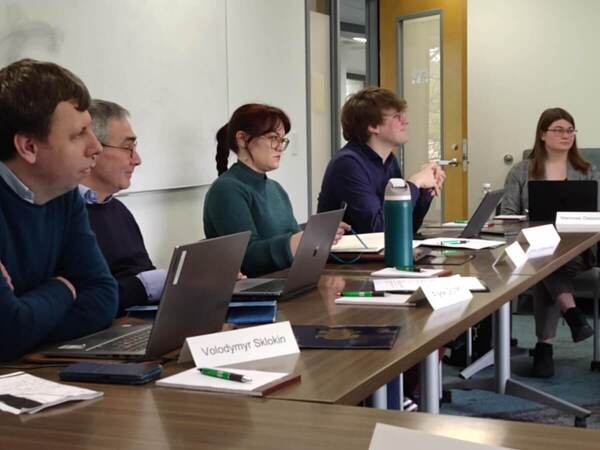
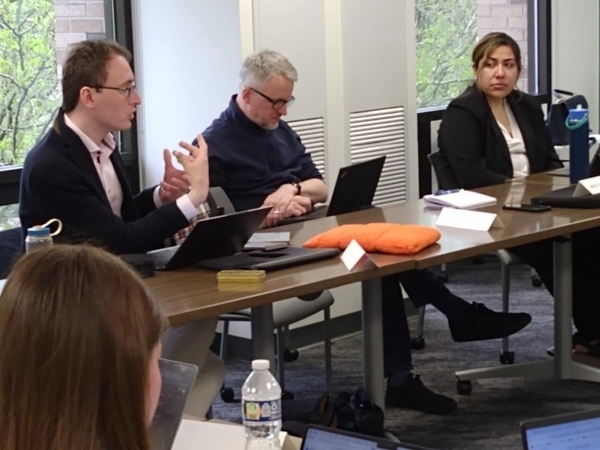

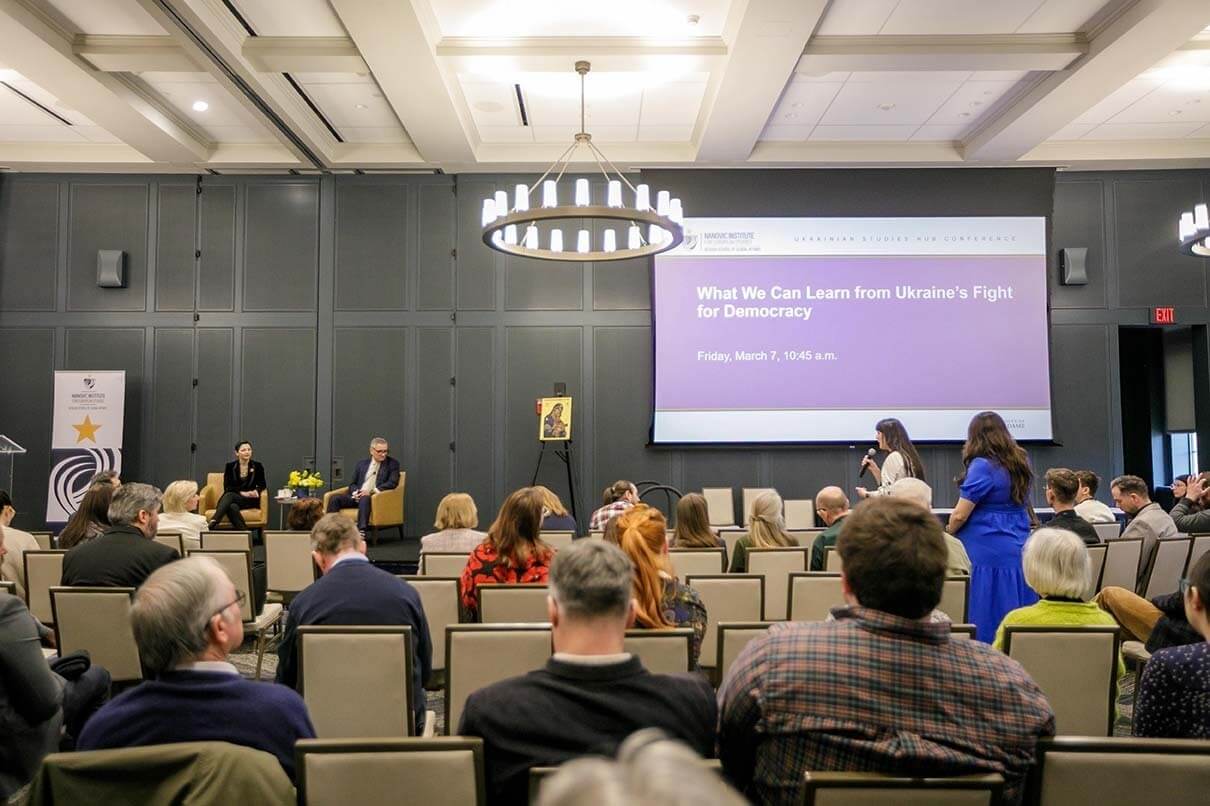




 (Source: